

What if the standard 5-inch gutter you see on every neighbor’s house is actually the silent culprit behind your recurring basement dampness? Many homeowners assume all gutters are created equal, but during a heavy Massachusetts nor’easter, an undersized system quickly becomes a liability rather than a protector. You’re likely asking, “what size gutters do I need for my house” because you’ve seen the overflow during a summer storm or you’re worried about the structural integrity of your foundation.
We understand that you want a solution that works without paying for an unnecessary industrial upgrade. Our goal is to give you total confidence in your home’s drainage system. In this guide, you’ll learn how to calculate the perfect gutter size to prevent water damage and ensure long-term roof protection. We’ll walk through the relationship between your roof’s square footage and pitch, explain why the 2026 Massachusetts building codes matter for your installation, and help you decide if 6-inch gutters offer the best return on your investment for the seasons ahead.
Key Takeaways
- Learn the exact calculations used to answer “what size gutters do I need for my house” by balancing your roof’s square footage with local rainfall data.
- Discover why a steep roof pitch requires higher capacity gutters to prevent overflow and protect your home’s foundation.
- Compare the performance of 5-inch and 6-inch systems to find the right balance between cost and long-term drainage security.
- Understand how the right gutter size helps manage the unique challenges of Massachusetts weather, including heavy snow and ice dam prevention.
- Identify which gutter materials offer the best durability and why professional pitch adjustments are essential for a reliable system.
Understanding Gutter Sizes: Why Width and Depth Matter
A Rain gutter is more than just a metal trough attached to your roofline. It is a precision-engineered component of your home’s exterior defense system. When professionals talk about gutter size, they are referring to the horizontal measurement across the top opening of the trough. This width determines the “catchment” potential of the system. If the opening is too narrow, water from a heavy downpour will simply overshoot the gutter, leading to foundation erosion and basement dampness. Our goal is to ensure your home remains a dry, secure sanctuary regardless of the weather outside.
The primary purpose of this system is to collect runoff and direct it safely away from your foundation and roof edge. Most residential properties in Massachusetts utilize K-style gutters, which are designed to mimic the appearance of crown molding while providing high structural strength. When you start asking, “what size gutters do I need for my house,” you are essentially looking for the right balance of volume capacity. While width is the standard metric, it’s the total volume that matters. A gutter must be deep and wide enough to handle the peak flow of a storm without backing up.
The Role of Gutters in Roof Longevity
Undersized gutters are a leading cause of premature roof failure. When a gutter reaches its capacity and overflows, the water doesn’t only spill over the front edge. It often “wicks” backward, soaking into the fascia boards and seeping under the bottom layer of shingles. This constant moisture exposure rots the roof deck and weakens the structural perimeter of your home. We frequently find that homeowners who neglect their gutter sizing eventually require professional roof leak repair to fix damage that could have been prevented with a higher-capacity system. Keeping your gutters flowing freely is the first step in protecting your most valuable asset.
Standard vs. Oversized: A Quick Look
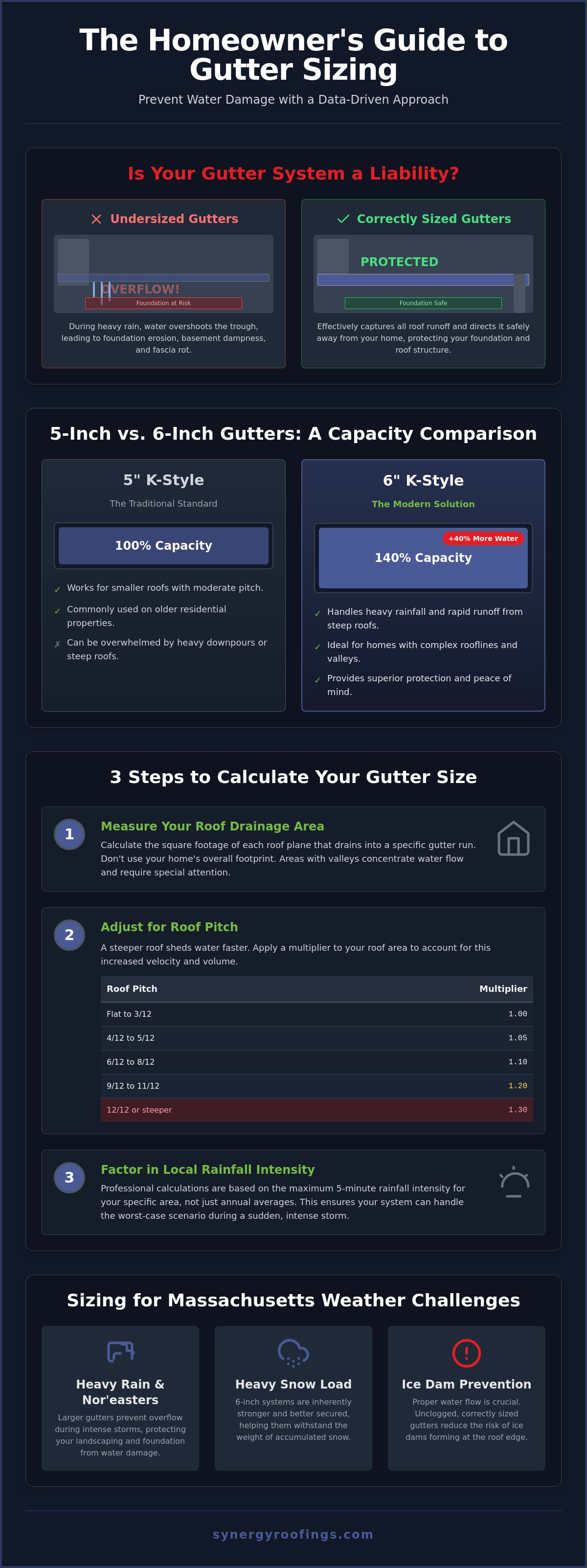
For decades, the 5-inch K-style gutter was the undisputed residential standard. It works well for homes with average roof sizes and moderate pitches. However, the 6-inch “oversized” gutter has become the modern choice for many homeowners seeking extra peace of mind. The difference isn’t just an inch of metal. A 6-inch gutter actually holds nearly 40% more water than its 5-inch counterpart. This extra capacity is vital for homes with steep gables or complex rooflines where water gathers speed as it sheds. You may also consider half-round gutters for a historic aesthetic, though these typically require larger sizing to match the drainage performance of K-style troughs.
How to Calculate the Gutter Size for Your House
Calculating the right dimensions for your drainage system is a hydraulic engineering task, not just a trip to the hardware store. To accurately answer the question, “what size gutters do I need for my house,” we analyze the specific physics of your property. We look at the total drainage area, the steepness of your roof, and the historical weather patterns of your local area. By following a structured math framework, you can move from uncertainty to a clear, data-backed decision that protects your home for decades.
Step 1: Measuring Your Roof Drainage Area
The first step involves measuring the square footage of each roof plane. It’s a common mistake to use the total square footage of your home’s footprint. Instead, you must calculate the area of every individual surface that drains into a specific gutter run. For a simple gable roof, you’ll measure the length and width of the two main slopes. If your home features complex rooflines with multiple valleys, these areas require more careful attention. These valleys concentrate water into specific points, creating a high-velocity flow that can easily overwhelm a standard system.
Step 2: Adjusting for Roof Pitch
Roof pitch, or steepness, significantly changes how much water your gutters must handle. A steep roof “catches” more wind-blown rain and delivers it to the trough much faster than a flat surface. This is why we apply a “Roof-Pitch Factor” to your square footage. This multiplier increases your effective drainage area to account for the speed and volume of runoff. The steeper the roof, the higher the capacity your gutters need to have.
- Flat to 3/12 pitch: 1.00 multiplier
- 4/12 to 5/12 pitch: 1.05 multiplier
- 6/12 to 8/12 pitch: 1.10 multiplier
- 9/12 to 11/12 pitch: 1.20 multiplier
- 12/12 or steeper: 1.30 multiplier
Step 3: Factoring in Local Rainfall Intensity
Finally, we factor in local rainfall intensity. Sizing is based on maximum 5-minute rainfall bursts rather than annual totals. According to Gutter sizing and capacity standards, systems must be designed for these peak events to prevent overflow. In Norfolk County, Massachusetts, we typically account for an intensity of roughly 6.2 inches per hour during a 10-year storm event. When you multiply your adjusted square footage by this rainfall factor, you get a “Gallons Per Minute” (GPM) requirement. If your calculated GPM exceeds the capacity of a standard 5-inch trough, an upgrade is necessary. If these calculations feel overwhelming, our team at SYNERGY ROOFING – ROOFING & SKYLIGHT SPECIALIST can provide a professional assessment to ensure your system is perfectly calibrated for your specific roofline.
5-Inch vs. 6-Inch Gutters: Which is Right for You?
Choosing between the two most common gutter widths is the final step in securing your home’s exterior. While the technical calculations provide a baseline, the practical reality of your property’s architecture often tips the scale. If you are still asking yourself, “what size gutters do I need for my house,” the decision usually comes down to balancing immediate budget needs with the long-term security of a high-capacity system. Both sizes offer reliable protection, but they serve very different functional purposes depending on your roof’s profile.
The aesthetic impact is another factor many homeowners overlook. A 5-inch gutter is low-profile and blends seamlessly into the fascia of traditional or smaller homes. In contrast, 6-inch gutters have a more robust, substantial appearance. This can provide a clean, modern look for larger estates or homes with wide trim boards. Beyond looks, the larger size is a pragmatic choice that simplifies maintenance. The wider opening makes it significantly easier to clear out debris, allowing for better airflow and faster drying of the trough after a storm.
When 5-Inch Gutters Are Sufficient
A standard 5-inch system remains a dependable choice for many residential properties. It’s typically ideal for smaller ranch-style homes or houses with simple gable roofs and moderate pitches. If your home has a relatively small drainage area per gutter run, this size provides ample protection. You can often compensate for the smaller trough volume by increasing the number of downspouts. According to the International Residential Code (IRC), you should have at least one downspout for every 40 linear feet of gutter. Adhering strictly to this standard ensures that even a 5-inch system can handle typical rainfall without backing up, making it a cost-effective solution for standard residential needs.
The Case for Upgrading to 6-Inch Gutters
Upgrading to a 6-inch system is often a necessity rather than a luxury. This is particularly true for homes with metal roofing, where water sheds with much higher velocity than it does on asphalt shingles. The extra width is also crucial for long gutter runs exceeding 40 feet. In these instances, water accumulates quickly as it travels toward the downspout, and a standard trough may overflow before the water can escape.
One of the greatest advantages of the 6-inch system is the ability to pair it with oversized 3×4-inch downspouts. These larger outlets are far less prone to clogging from leaves or twigs. This creates a high-performance drainage loop that requires less frequent intervention from you. For homeowners dealing with steep pitches or complex valleys, the 6-inch upgrade offers the “quiet confidence” that your foundation is protected during even the most intense cloudbursts.
Massachusetts Weather Factors: Snow, Ice, and Heavy Rain
Living in Norfolk County or the Medway area means your home faces a unique set of environmental stressors. From heavy spring rains to the weight of mid-winter snow, your drainage system must be resilient. When you ask, “what size gutters do I need for my house,” you aren’t just thinking about rain. You’re considering the structural burden of frozen precipitation. Seamless gutter technology is a critical standard here. By eliminating the seams found in sectional systems, you reduce the weak points where ice expansion can cause failures during the harsh New England winter.
The weight of snow is a major factor in Massachusetts. A standard gutter filled with wet snow and ice can weigh hundreds of pounds. This is why the mounting hardware and the gauge of the metal are just as important as the width. We ensure that every installation is built to withstand these loads, providing a foundation of security that prevents the system from pulling away from your fascia boards. High-moisture climates demand this level of durability to prevent long-term rot and structural damage.
Ice Dam Prevention and Gutter Sizing
Ice dams occur when heat escapes through your asphalt shingle roofing, melting the snow above. This water then refreezes at the colder eaves. While gutters don’t cause ice dams, their size influences how meltwater is managed. A 6-inch gutter provides a wider trough that can accommodate heat cable integration more effectively than a 5-inch version. This extra space allows for better drainage during the critical freeze-thaw cycles. It’s a proactive way to safeguard your roof deck and interior ceilings from water intrusion.
Managing Norfolk County Storm Intensity
The 2025 and 2026 storm seasons in the Boston area have shown a marked increase in rainfall intensity during short, volatile bursts. We’ve seen traditional 5-inch systems overwhelmed by sheer volume in a matter of minutes. Choosing a larger gutter size provides a vital safety margin against this climate volatility. It ensures that even if a storm exceeds historical averages, your home remains protected. This is about more than just drainage. It’s about the psychological relief of knowing your property is prepared for the next big front. If you’re concerned about your current system’s capacity, you can schedule a professional Gutter Installation assessment with our team at SYNERGY ROOFING – ROOFING & SKYLIGHT SPECIALIST to find the right fit for your home.
Choosing the Best Gutter Material and Professional Installer
Once you’ve determined the answer to “what size gutters do I need for my house,” the final step is selecting the right materials and the right partner to execute the installation. A gutter system is only as effective as the material it’s made from and the precision with which it’s mounted. In the volatile Massachusetts climate, your choice of material impacts everything from curb appeal to how many decades the system will remain functional without requiring replacement.
We view gutters as a critical component of your home’s “protective envelope.” This means the system must work in harmony with your roof, siding, and even your ground-level investments like decking installation. When water is managed correctly at the roofline, it protects your deck from rot and your siding from unsightly splash-back stains. Choosing a professional roofing company in Massachusetts ensures that these interconnected systems are handled with a holistic understanding of home protection.
Material Selection for Longevity
Aluminum remains the residential standard for a reason. It’s lightweight, rust-proof, and available in a wide array of colors to match your home’s trim. For many homeowners in Medway and Norfolk County, aluminum provides the best balance of performance and value. However, for historic homes or those seeking a “forever” solution, copper is the ultimate choice. Copper gutters develop a beautiful patina over time and are often used as elegant accents alongside a Velux skylight installation to elevate a home’s aesthetic. Galvalume, a steel substrate coated with aluminum and zinc, offers another high-durability option for those who prefer a modern, industrial look with superior corrosion resistance in high-humidity environments.
The Importance of Professional Pitching
The most common failure in DIY gutter projects is incorrect pitching. Even a high-capacity 6-inch gutter will fail if it’s not sloped precisely toward the downspouts. Water that doesn’t move becomes “standing water,” which creates a breeding ground for mosquitoes and adds unnecessary weight to your fascia boards. During our installation process, we use laser-level precision to ensure the pitch is steep enough to move debris but subtle enough to maintain the home’s visual lines. We treat every gutter run as a custom engineering project, ensuring your home remains dry and your foundation stays secure.
Next Steps for Your Home
Don’t wait for the next major storm to find out if your gutters are undersized or failing. A professional gutter audit can identify small issues before they turn into foundation repairs or basement floods. Our team at SYNERGY ROOFING – ROOFING & SKYLIGHT SPECIALIST has decades of specialized knowledge in Medway and surrounding towns, helping neighbors protect their most significant priorities with quiet confidence. Whether you need a simple upgrade or a total system redesign, we are here to act as your protective partner. Schedule your professional gutter consultation with SYNERGY ROOFING – ROOFING & SKYLIGHT SPECIALIST today and ensure your home is ready for the 2026 season.
Securing Your Home Against the Next Storm
Your home’s defense against water damage starts at the roofline. By understanding that gutter sizing is a precise calculation of your roof’s drainage area and local rainfall intensity, you’ve taken a significant step toward safeguarding your property. We’ve explored how 6-inch systems offer a vital safety margin during heavy Norfolk County storms and why professional pitching is the secret to a dry foundation. Determining what size gutters do I need for my house doesn’t have to be a source of stress when you have the right data and a reliable partner.
At Synergy Roofing, we specialize in the unique weather challenges of the Medway area. Our expertise in both roofing and gutter integration allows us to treat your exterior as a single, protective system. We’re here to help you move from concern to resolution with expert guidance and high-quality materials. Protect your home with a professional gutter estimate from Synergy Roofing. You deserve the confidence that comes with a perfectly calibrated drainage system. Let’s ensure your home remains a secure sanctuary for years to come.
Frequently Asked Questions
Can I have 5-inch gutters on one part of my house and 6-inch on another?
Yes, you can certainly mix gutter sizes on a single property. It is a practical solution for homes with varying roof heights or complex additions. For example, you might install 6-inch gutters on a steep rear gable that handles a massive volume of runoff while keeping standard 5-inch gutters on a small front porch or a lower garage roof. This targeted approach ensures every section of your home has the protection it needs without over-engineering areas with minimal drainage requirements.
How do I know if my current gutters are too small?
The most obvious sign that you’re asking “what size gutters do I need for my house” too late is seeing water overshoot the trough during a typical storm. You should also look for “tiger stripes” or dark water stains on your siding, which indicate consistent overflow. If you notice soil erosion or mulch being washed away directly beneath your eaves, your current system is likely undersized and unable to keep up with the peak flow of local rain events.
Do 6-inch gutters clog less often than 5-inch gutters?
Larger 6-inch gutters are significantly less prone to clogging because they accommodate wider outlets. While the trough itself provides more room for debris to move, the real benefit comes from the larger downspouts typically paired with these systems. These oversized openings allow small twigs and leaves to pass through rather than snagging at the entrance. This results in a more reliable system that requires less frequent maintenance to keep your home’s exterior safe from water backups.
What is the standard downspout size for a 6-inch gutter?
A 6-inch gutter system is almost always paired with 3×4-inch oversized downspouts. In contrast, standard 5-inch gutters typically use smaller 2×3-inch versions. The larger downspout capacity is essential because it matches the increased volume of the wider trough. This combination ensures that the water collected from your roof can be discharged quickly and efficiently, preventing the bottleneck effect that often leads to gutter failure during intense cloudbursts.
Are seamless gutters available in both 5 and 6-inch sizes?
Yes, seamless gutters are custom-fabricated on-site in both 5-inch and 6-inch widths. A professional installer uses a specialized machine to roll-form the metal to the exact length of your roofline. This eliminates the seams that are common in store-bought sectional gutters. Whether you choose the standard or oversized option, the seamless design provides a cleaner aesthetic and significantly reduces the risk of leaks at the joints, which is vital for long-term property protection.
How much more do 6-inch gutters cost compared to 5-inch?
The cost of 6-inch gutters is typically higher than 5-inch versions due to the increased amount of material required for the larger troughs and downspouts. While the initial investment is greater, many homeowners find the return on investment comes through reduced maintenance and better protection against foundation damage. When you consider “what size gutters do I need for my house” in terms of long-term value, the oversized system often pays for itself by preventing expensive repairs to your siding and basement.
Will larger gutters help prevent basement leaks?
Larger gutters play a direct role in preventing basement flooding by managing the volume of water near your foundation. When gutters overflow, water pools at the base of your home and eventually seeps through foundation cracks or into crawlspaces. A 6-inch system handles the runoff from heavy storms more effectively, ensuring that water is captured and moved to downspout extensions that discharge far away from your home’s structural footprint.
Does roof pitch really affect what size gutter I need?
Roof pitch is one of the most critical factors in gutter sizing because it determines the speed of the water. A steep roof acts like a slide, accelerating runoff and catching more wind-blown rain than a flatter surface. If your home has a steep pitch, a 5-inch gutter may be physically too narrow to catch the water before it shoots over the front edge. In these cases, upgrading to a 6-inch trough is a necessary step to ensure the system actually performs its job.