

Cutting a massive hole in your roof is often the least effective way to brighten a windowless corridor. You likely feel the sting of high electricity bills every time you flip that hallway switch at noon just to see where you’re walking. When comparing a sun tunnel vs skylight for dark hallway spaces, most homeowners in Massachusetts worry about more than just brightness. You want a welcoming home, but you also need the peace of mind that your roof won’t leak during a February ice storm or fail to meet modern thermal standards.
At Synergy Roofing, we believe your home’s structural integrity and your daily comfort should work in harmony. You don’t have to choose between a gloomy interior and a risky renovation. This 2026 guide compares the $850 average cost of a tubular sun tunnel against the $2,115 average for a traditional skylight. We’ll explore how your attic’s anatomy and the latest Massachusetts building codes, which mandate a U-factor of 0.45 or lower, dictate the right choice for your roof. You’ll discover which installation offers a leak-proof, 20-year solution that maximizes your home’s value without the anxiety of future repairs.
Key Takeaways
- Understand the fundamental differences between reflective tubular systems and traditional roof-mounted windows to see which fits your hallway’s specific aesthetic and lighting needs.
- Evaluate your attic’s “run” and roof pitch to ensure a leak-proof installation that stands up to the unique demands of Massachusetts winter weather.
- Compare the total investment of a sun tunnel vs skylight for dark hallway projects, including the 2026 average price gap of over $1,200 between these two solutions.
- Learn how to maintain your home’s thermal integrity by selecting units that meet the latest energy performance standards for U-factors and solar heat gain.
- Get a clear verdict on which solution provides the best long-term value and peace of mind based on your ceiling type and architectural goals.
Understanding Sun Tunnels and Skylights for Hallway Lighting
Hallways in Massachusetts homes are often the last place to see the sun. Because they are typically nestled between bedrooms and bathrooms, they lack external walls for traditional windows. When you’re deciding between a sun tunnel vs skylight for dark hallway renovations, you are choosing between tactical illumination and architectural drama. A traditional skylight is a roof-mounted window that offers a direct view of the sky and brings in a high volume of natural light. In contrast, a sun tunnel is a reflective piping system designed to funnel light from the roof into spaces where a standard window isn’t feasible.
To see these systems in action and understand the visual difference, watch this helpful comparison:
Many homeowners prioritize “tactical lighting” for their corridors. You don’t necessarily need a view of the clouds while walking to the laundry room; you just need to see where you’re going without tripping or hiking up the electric bill. Comparing a sun tunnel vs skylight for dark hallway illumination requires looking at how light tubes work. These systems use nonimaging optics to capture light at a roof dome and bounce it down a highly reflective path. This provides consistent, soft brightness even on overcast New England days. At Synergy Roofing, we often recommend this approach for homeowners who want the benefits of natural light without the structural complexity of a full window installation.
The Anatomy of a Hallway Skylight
A skylight requires a clear, direct path between your roof and your ceiling. If your hallway has a vaulted ceiling, a skylight is a seamless addition that makes narrow corridors feel significantly taller. If there’s an attic in between, we must build a custom-framed light well. This “window to the sky” adds an architectural element that a simple light fixture can’t match. It transforms a functional transition space into an airy gallery, though it requires more roof real estate and precise flashing to ensure durability.
How Sun Tunnels Navigate Attic Obstacles
Sun tunnels are the problem-solvers of the roofing world. They use flexible or rigid tubes to snake around HVAC ducts, chimneys, or complex rafters that would block a traditional skylight. This makes them the primary choice for first-floor hallways in two-story homes or houses with deep, cluttered attics. The roof dome captures daylight and “pours” it through a ceiling diffuser, mimicking the look of a high-end recessed light. It’s a low-profile solution that protects your roof’s integrity while flooding the darkest corners of your home with natural light.
Direct Comparison: Performance, Light Quality, and Aesthetics
Choosing between a sun tunnel vs skylight for dark hallway spaces often comes down to how you want the light to behave. A traditional skylight provides a massive volume of raw light, often exceeding 3,000 lumens depending on the unit size. However, in a narrow corridor, this can create intense “hot spots” and deep shadows on the walls. Sun tunnels are more focused. They use a ceiling-mounted diffuser to spread light evenly, creating a consistent glow that mimics a high-end electric fixture. This makes the hallway feel naturally bright without the glare of direct sunbeams.
You should also consider the “view factor.” While a skylight offers a beautiful window to the clouds, a hallway is rarely a place where people linger to stargaze. If your goal is purely functional brightness, the sun tunnel’s tactical approach is often superior. Both options now feature advanced UV protection. Modern glass and diffusers filter out up to 99% of harmful rays, protecting your hardwood floors and family photos from fading over time. This protection is a standard part of our commitment to craftsmanship and durability.
Safety doesn’t stop when the sun goes down. Many 2026 models include integrated LED light kits. These allow your sun tunnel or skylight to act as your primary hallway light at night, providing a seamless transition from natural to artificial light. If you’re unsure which setup fits your roofline, our team can help you find the best lighting solution for your home’s specific layout.
Light Distribution in Narrow Spaces
Skylights can be overwhelming in tight quarters. The light well often creates a bulky visual presence if the attic is deep. Sun tunnels use a ceiling-mounted diffuser to eliminate harsh glares and provide a soft, ambient light. When selecting a sun tunnel, remember that rigid tubes provide the highest performance. They can transfer light over 20 feet with minimal loss, while flexible tubes are better for shorter runs where you need to navigate around structural obstacles like HVAC ducts.
Visual Impact on Your Home’s Interior
From a design perspective, a skylight is a bold statement. It adds architectural volume and can make a cramped hallway feel like an open gallery. This “wow” factor is a strong selling point in the Medway, MA real estate market, where natural light is a high-demand feature. Conversely, sun tunnels offer a discreet, modern look. They appear almost identical to a standard recessed light, maintaining a clean ceiling line while providing significantly more brightness than a typical 60-watt bulb. Both choices increase home resale value, but the skylight is the clear winner for architectural drama.
Structural Requirements and Massachusetts Weather Protection
MA winters don’t play around. Heavy snow and ice can turn a poorly installed roof feature into a major liability. When we evaluate a sun tunnel vs skylight for dark hallway projects, the physical “run” is our first measurement. This is the vertical distance between your roof deck and the hallway ceiling. A sun tunnel handles long distances with ease, using rigid tubing to travel up to 20 feet through an attic. A traditional skylight, however, requires a framed-in light well. This well consumes significant attic space and requires precise carpentry to ensure the weight is distributed correctly across your rafters.
Safety is paramount in New England. We only install units featuring tempered, impact-resistant glass designed to withstand the pressure of a 12-inch snowpack. If you’ve dealt with moisture issues in the past, you know that prevention is better than a cure. You can learn more about maintaining your home’s defense in our guide to roof leak repair in Massachusetts. Integrity starts with the flashing, and we utilize heavy-duty materials that create a seamless seal against asphalt shingles or metal roofing.
Avoiding Ice Dams and Thermal Loss
Improperly insulated light wells are a leading cause of ice dams. Heat from your hallway can rise into the well, melting snow on the glass which then refreezes at the cold eaves. We prevent this by using high-performance insulation and vapor barriers around the entire installation. This protects your home’s thermal envelope during a January freeze and prevents condensation during our humid summer months. Every installation is a partnership between the materials and our craftsmanship to ensure your peace of mind.
Attic Constraints: HVAC, Wiring, and Rafters
Your attic isn’t a blank canvas. It’s a complex network of systems that can dictate your lighting choices. Sun tunnels are the “surgical” choice because their 10-inch or 14-inch diameter allows them to slip between standard 16-inch or 24-inch on-center rafters. This avoids the need for structural header work. Before choosing your light source, we identify several “no-go” zones in your attic:
- Main structural load-bearing rafters that cannot be cut without extensive shoring.
- Central HVAC trunk lines that are too costly to reroute.
- Primary electrical panels or thick wire bundles serving the second floor.
- Plumbing vent stacks that require a direct vertical path through the roof.
If your hallway is directly under a vaulted roof with no attic, a skylight is often the straightforward winner. For homes with deep, cluttered attics, the flexibility of a sun tunnel ensures we can deliver light without disturbing your home’s vital systems.
Costs, Energy Efficiency, and Long-Term Value
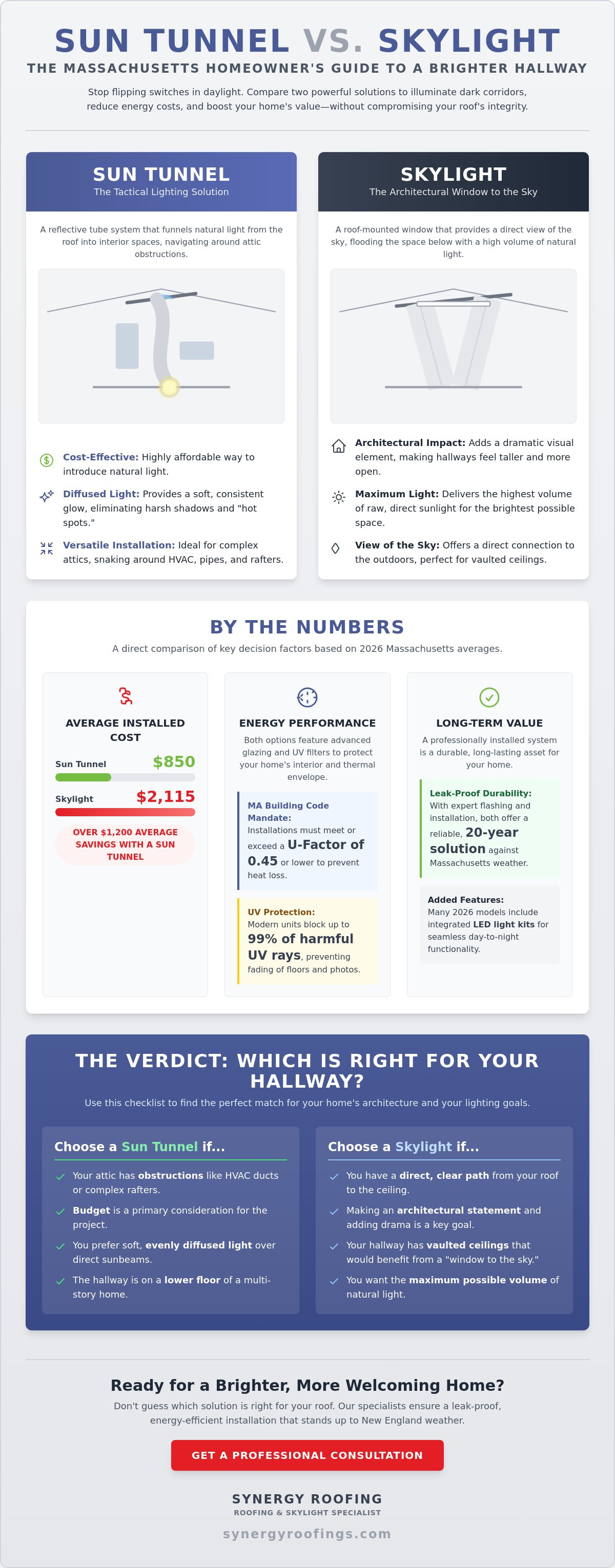
Financial clarity is the foundation of any successful home project. When we weigh the investment of a sun tunnel vs skylight for dark hallway upgrades, the upfront numbers tell a clear story. According to 2026 national averages, a sun tunnel installation typically costs around $850, while a traditional skylight averages $2,115. This makes the tubular option roughly 60% more affordable for homeowners who want to maximize their budget. While the skylight offers a larger surface area for light, the sun tunnel provides a high-performance alternative that doesn’t require the same level of structural modification.
Energy efficiency is another area where these two solutions diverge. In the cold New England climate, your roof’s thermal integrity is vital. Massachusetts building codes in 2026 require a U-factor of 0.45 or lower for all skylight installations. Sun tunnels often exceed these standards because their smaller footprint reduces the potential for heat loss. They act as a sealed system, minimizing the solar heat gain that can make your home uncomfortable during a humid July. This balance of light and insulation ensures your hallway stays bright without taxing your HVAC system.
Maintenance is a factor that many people overlook until the first streak of dirt appears. Traditional skylights require periodic cleaning to maintain their clarity, much like a standard window. Sun tunnels, however, are largely “set it and forget it” systems. The protective roof dome is designed to shed debris naturally, and the sealed tube prevents dust from entering the diffuser. If you’re ready to see how these options fit your budget, you can request a professional consultation to get started.
As of May 2026, it’s important to understand the current incentive landscape. The Federal 25C Energy Efficient Home Improvement Credit expired on December 31, 2025, and is no longer available for new installations. While Massachusetts offers a 15% state tax credit for solar installations, this is primarily capped at $1,000 and aimed at photovoltaic systems. Because these federal credits have ended, the lower initial cost of a sun tunnel vs skylight for dark hallway projects becomes an even more attractive factor for cost-conscious homeowners.
The ROI of Natural Hallway Lighting
The return on your investment goes beyond the initial price tag. By eliminating the need for “always-on” hallway lights, you can see a noticeable reduction in your monthly electricity usage. There’s also a psychological benefit to consider. Natural light is proven to improve mood and productivity, which is a significant advantage during the long, dark Massachusetts winters. In the Norfolk County real estate market, a bright, airy hallway is a “wow” factor that can help your home sell faster and for a higher price than a house with dim, windowless corridors.
Longevity and Warranty Peace of Mind
We believe in protecting what matters most by using materials that stand the test of time. That’s why we rely on Velux products, which come with a 10-year “No Leak” installation warranty when handled by a certified professional. While a DIY approach might seem cheaper initially, a single mistake in flashing or underlayment can lead to thousands of dollars in water damage. Our commitment to craftsmanship ensures that your installation remains seamless and durable for 20 years or more, giving you the security you deserve.
The Verdict: Which Should You Choose for Your Hallway?
Deciding between a sun tunnel vs skylight for dark hallway spaces comes down to your home’s unique structural blueprint and your personal design goals. If your hallway sits beneath a deep attic with complex rafters or HVAC ducts, the sun tunnel is your most reliable ally. It is the surgical, budget-friendly choice for tight spaces where you need consistent light without a major renovation. Conversely, if you have a vaulted ceiling or want to create a stunning architectural focal point that offers a view of the sky, a traditional skylight is the superior investment. While it requires more intensive labor, the dramatic increase in perceived space and the option for ventilation can transform a cramped corridor into an airy gallery.
Our “Synergy Process” takes the guesswork out of this decision. We don’t just look at the ceiling; we evaluate the entire system from the shingles down to the drywall. We measure the attic run, check for structural obstructions, and assess your roof’s pitch to ensure that whichever option you choose maintains the integrity of your home’s defense. We believe that the best results come from a collaborative relationship between our experts and your vision. If you are ready to stop relying on artificial bulbs and start enjoying the benefits of natural light, contact Synergy Roofing for a professional skylight or sun tunnel consultation today.
Why Professional Installation is Non-Negotiable
The biggest risk with any roof penetration is a failure in the flashing system. In our local climate, a minor gap in the underlayment can lead to ice dams or persistent leaks that damage your hallway’s interior finish. Professional installation ensures that the transition between your roofing material and the new light source is seamless and durable. We focus on high-quality craftsmanship that prevents common issues like chimney-adjacent leaks or condensation buildup. For a deeper look at how we handle these projects locally, read our guide on Velux Skylight Installation in Medway.
Taking the Next Step for a Brighter Home
Transforming your home shouldn’t be a source of stress. When you schedule a site visit with our team, we provide a clear, honest assessment of what’s possible for your specific roofline. For most sun tunnel projects, we can complete the entire installation in a single day, meaning you can leave for work in the morning and return to a bright, welcoming hallway by dinner. This efficiency doesn’t come at the expense of quality. We stand by our work and the premium materials we use, ensuring you have total peace of mind. Our goal is always the same: protecting what matters most while making your home a more beautiful place to live.
Transform Your Home with Natural Light
Choosing between a sun tunnel vs skylight for dark hallway projects depends on your attic’s depth and your architectural vision. Whether you opt for the cost-effective sun tunnel or the dramatic volume of a traditional skylight, you’re investing in long-term energy savings and a brighter daily environment. Our team ensures that every installation meets the 2026 Massachusetts building codes for thermal protection and structural integrity.
Synergy Roofing brings over 20 years of Massachusetts roofing expertise to every project. We handle the technical complexities of flashing and insulation so you don’t have to worry about leaks or ice dams. As a Velux 5-Star Certified Installer with an A+ BBB rating, we’re here to provide the peace of mind you need when modifying your roof. Brighten your home with a free skylight estimate from Synergy Roofing and take the first step toward protecting what matters most. You deserve a home that feels open and inviting every time you walk through the door.
Frequently Asked Questions
Do sun tunnels provide as much light as a regular skylight?
Sun tunnels provide a concentrated glow, but they don’t produce the same raw light volume as a traditional skylight. A standard skylight can flood a space with over 3,000 lumens of raw light. In a sun tunnel vs skylight for dark hallway comparison, the tunnel is designed for tactical brightness rather than a massive wash of light. It’s the ideal choice for smaller corridors where you want to eliminate shadows without the intensity of a full window.
Can a sun tunnel leak during heavy Massachusetts snowstorms?
Leakage is a result of poor craftsmanship, not the product itself. When we install these systems, we use high-performance flashing and underlayment to create a seamless seal against the elements. Because we are Velux 5-Star Certified, your installation is backed by a 10-year “No Leak” warranty. This provides the peace of mind you need during a heavy Massachusetts snowpack or a sudden spring thaw. Our team ensures every roof penetration remains structurally sound.
How long does it take to install a sun tunnel vs. a skylight in a hallway?
A sun tunnel usually takes a single day to install, while a skylight requires a multi-day timeline. Because a skylight in a hallway often involves building a custom-framed light well through the attic, the process typically spans two to three days. Sun tunnels are more surgical, fitting between standard rafters without structural changes. This speed makes them a low-friction solution for busy homeowners who want immediate results without a long construction schedule.
Are there federal tax credits available for sun tunnels in 2026?
There are currently no federal tax credits available for these installations in 2026. The Energy Efficient Home Improvement Credit (25C) expired on December 31, 2025. While Massachusetts offers a 15% state credit for solar systems, it is primarily designed for photovoltaic panels rather than passive lighting solutions. We recommend consulting a tax professional to see if any local municipal incentives have recently been introduced in your specific Norfolk County town.
Do I need to clean the inside of a sun tunnel or skylight?
Sun tunnels are virtually maintenance-free because they are sealed units. The interior reflective tube stays clean because dust and insects can’t get inside the diffuser or the roof dome. Traditional skylights, however, require occasional cleaning just like any other window in your home. If your hallway skylight is out of reach, you may need a telescopic pole or a professional service to keep the glass clear of pollen and dust accumulation throughout the year.
Will a skylight make my hallway too hot during the summer?
Modern units won’t overheat your home if they meet the 2026 Massachusetts building code standards. All new installations must have a U-factor of 0.45 or lower to prevent thermal transfer. Selecting a model with a Solar Heat Gain Coefficient of 0.40 or less ensures that the summer sun won’t turn your hallway into a greenhouse. Proper insulation around the light well is the key to maintaining a comfortable temperature and protecting your home’s thermal envelope.
Can you install a sun tunnel on a first-floor hallway of a two-story home?
Yes, we can install a sun tunnel on the first floor of a two-story home. This is a common solution when deciding between a sun tunnel vs skylight for dark hallway spaces on a lower level. We use rigid tubing to navigate through the second-story attic or closet spaces, traveling up to 20 feet to deliver light. This flexibility allows us to brighten rooms that would otherwise be impossible to reach with a traditional vaulted window.
What happens if a sun tunnel gets covered in snow?
If a heavy snowpack covers the roof dome, the light in your hallway will diminish until the snow melts. However, the rounded shape of the dome is specifically designed to shed snow and debris naturally. Because the dome captures light from all angles, you’ll often see brightness even if only a small portion of the unit is exposed. Our installations prioritize durability to ensure the dome handles the weight of a 12-inch Massachusetts snowfall without compromising integrity.