

Most flat roofs in Massachusetts don’t fail because of their age; they fail because they lack the physical “memory” to survive a single Norfolk County winter. When the temperature drops and the freeze-thaw cycle begins, standard membranes often become brittle and crack under the constant expansion. If you’ve noticed recurring leaks or skyrocketing energy costs, you’re already feeling the impact of a roof that can’t keep up with New England’s demands. We understand how frustrating it is to feel like your property is vulnerable to the next big storm.
The good news is that sbs roofing systems massachusetts offer a high-quality, rubberized armor that’s specifically engineered to flex without breaking. In this 2026 guide, we’ll show you how modified bitumen provides a 20+ year waterproof solution that meets the state’s latest R-30 continuous insulation requirements. You’ll learn how these systems handle extreme snow loads and why they’re the smartest choice for protecting your investment against everything the 10th Edition of the Massachusetts State Building Code anticipates. Let’s explore how to turn your roof from a source of stress into a reliable, long-term shield for your property.
Key Takeaways
- Understand why the “rubberized” flexibility of SBS is essential for surviving New England’s freeze-thaw cycles without developing leaks or cracks.
- Discover how sbs roofing systems massachusetts provide superior impact resistance against hail and storm debris through high-quality multi-ply redundancy.
- Compare SBS with EPDM and TPO to see why modified bitumen often outperforms single-ply options in cold, high-moisture climates.
- Learn about the latest cold-applied and self-adhered installation techniques that offer a safer, fire-free alternative for residential and commercial property owners.
- Find out how to maximize your roof’s value by integrating SBS membranes with high-performance Velux skylights for improved thermal performance and natural light.
What is SBS Roofing and Why is it Essential for Massachusetts?
Most property owners don’t realize that a flat roof is a living part of the building. It needs to breathe, move, and adapt to its environment. SBS (Styrene-Butadiene-Styrene) is the technical term for a rubberized modified bitumen system. Unlike standard asphalt that becomes brittle and rigid when the temperature drops, SBS is modified with synthetic rubber to remain flexible. This flexibility is often the only thing standing between a dry interior and a midnight emergency leak during a sudden January thaw.
In Massachusetts, our roofs endure a massive thermal swing that would destroy lesser materials. We regularly see temperatures climb toward 90°F in July and plummet well below zero in February. When a standard material freezes, it loses its ability to stretch. If the building shifts slightly or the temperature drops rapidly, that rigid material simply snaps. sbs roofing systems massachusetts are specifically designed to handle this stress by utilizing multiple redundant layers of protection that move in harmony with your structure.
To better understand how these membranes are constructed and why they remain waterproof under extreme pressure, watch this helpful video:
The Science of ‘Rubberized’ Asphalt
The “memory” of SBS polymers is what truly sets this system apart. When the summer sun beats down on your low-slope roof, the material expands naturally. As the evening cools, it returns to its original shape without losing its seal or developing hairline fractures. This resilience is supported by internal reinforcement layers, usually made of high-strength fiberglass or polyester, which act as a skeleton to prevent punctures and tears. By combining these reinforcements with rubberized bitumen, the system gains the tensile strength necessary to withstand the heavy snow loads common in Norfolk County. SBS roofing is the premier multi-layer protection for low-slope structures in Massachusetts.
SBS vs. Traditional Built-Up Roofing (BUR)
For decades, flat roofs relied on traditional built-up roofing (BUR), commonly known as “hot tar and gravel.” While BUR served its purpose, it relied heavily on the contractor’s ability to mix and layer materials correctly on-site under varying weather conditions. SBS is a modern evolution of Asphalt roll roofing that brings factory-controlled precision to your property. Each sheet is manufactured to exact thickness and polymer ratios before it ever arrives at your home or business.
These factory-made sheets eliminate the inconsistencies often found in older roofing methods. Because the layers are bonded together during the manufacturing process, the risk of human error during installation is significantly reduced. At SYNERGY ROOFING – ROOFING & SKYLIGHT SPECIALIST, we utilize these advanced SBS membranes to solve the common failures we see in older flat-roof installations across Medway and the surrounding areas. You get a consistent, heavy-duty barrier that protects your property from the top down, year after year.
The Benefits of SBS Modified Bitumen for 2026 Property Owners
Property owners in 2026 are looking for more than just a leak-free roof; they need a system that contributes to the building’s overall energy strategy and long-term resilience. One of the standout features of SBS is its superior UV resistance. The mineral-surfaced cap sheets reflect a significant portion of solar radiation, protecting the underlying bitumen from the “cooking” effect that causes many flat roofs to fail prematurely. This reflective quality is a key part of reducing the heat island effect in developing commercial areas like Medway, helping you stay ahead of modern environmental standards.
Impact resistance is another critical advantage. Massachusetts weather is unpredictable, and falling debris from winter storms or occasional summer hail can easily puncture thinner materials. Because SBS is a multi-ply system, it offers redundant layers of protection that act as a shock absorber. According to the Whole Building Design Guide on Modified Bitumen, these systems are prized for their fatigue resistance and ability to withstand physical strain. This toughness ensures your property remains secure even when the environment becomes hostile.
Durability in the Face of New England Winters
New England winters present a unique set of challenges, specifically heavy snow accumulation and the pressure caused by ice dams. The structural integrity of sbs roofing systems massachusetts is designed to meet ASCE 7-22 standards for snow loads, ensuring the membrane doesn’t fail under weight. Its low-temperature flexibility is a lifesaver in January. While other materials might become brittle and crack, SBS remains pliable, allowing it to expand and contract without losing its waterproof seal. This makes it the preferred choice for low pitch roofing on residential additions where ice buildup is a constant concern.
Aesthetic and Functional Versatility
Beyond technical performance, SBS offers aesthetic choices that other flat roof materials often lack. You can select mineral granules that complement your existing asphalt shingles, making it an ideal choice for porches or garage additions. These systems are also incredibly durable underfoot. Unlike thin single-ply membranes that can be punctured by a dropped tool or a heavy branch, SBS handles foot traffic with ease. This makes it a perfect foundation for accessing roof-mounted equipment safely. Many homeowners choose to integrate these systems during a skylight replacement project to ensure a seamless, watertight transition between the new glass and the roof deck.
If a repair is ever needed, SBS is remarkably straightforward to maintain. You don’t need complex heat-welding equipment to fix a small puncture; most issues can be resolved with cold-process adhesives or simple patches. This ease of service keeps your long-term ownership costs predictable and low. If you want to ensure your building is protected by a system that’s built for the long haul, you can consult with our local experts to find the right configuration for your specific needs.
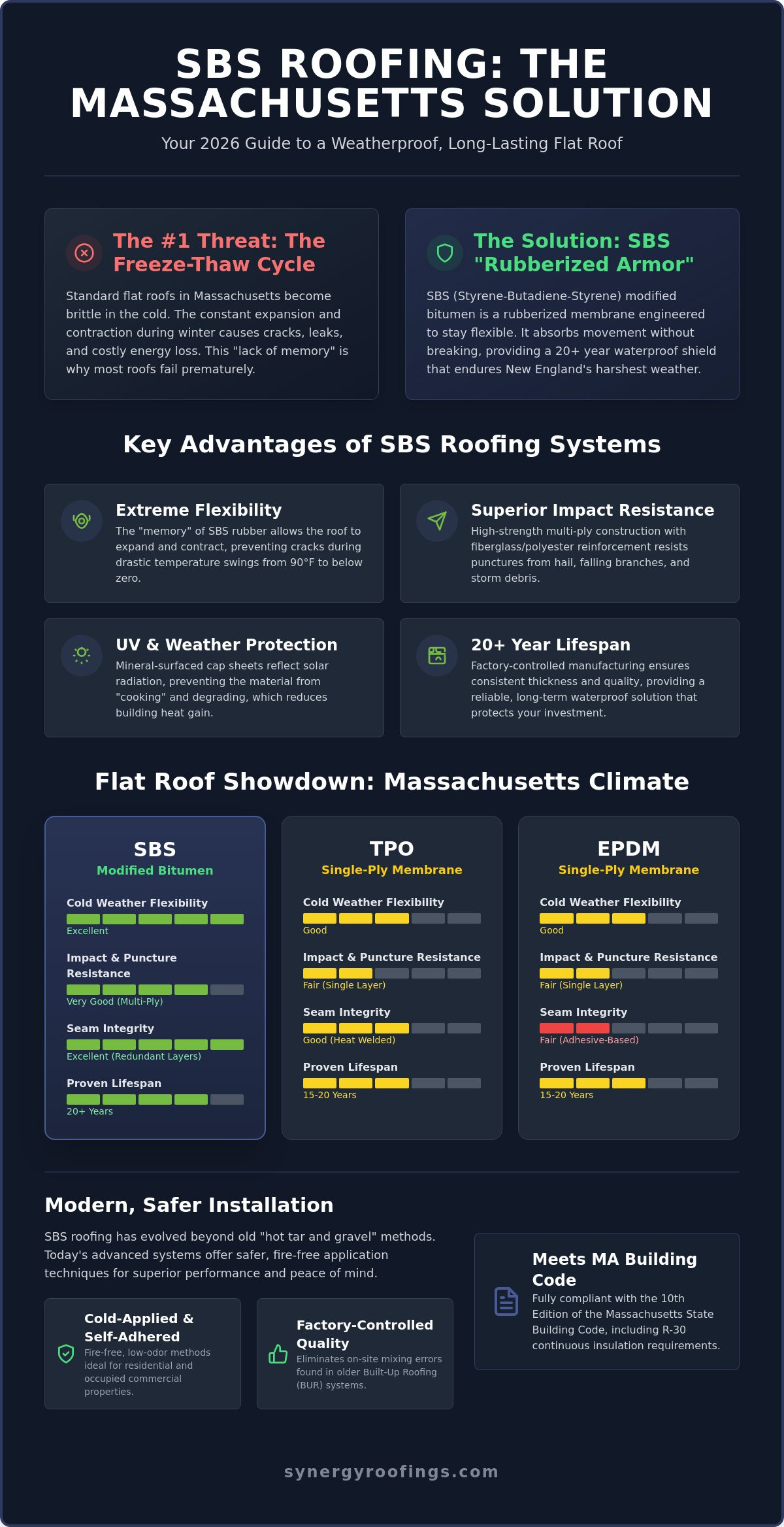
SBS vs. EPDM vs. TPO: Comparing Massachusetts Flat Roof Options
Choosing the right membrane for a flat roof in Massachusetts often comes down to three main contenders: EPDM, TPO, and SBS. While each has its place, the differences in their construction determine how well they’ll protect your property over the next three decades. EPDM, often simply called rubber roofing, is a traditional single-ply choice. It’s affordable and handles heat well, but it lacks the redundant layers found in multi-ply systems. If a single sheet of EPDM is punctured by a fallen branch or a sharp tool, your building is immediately vulnerable to water intrusion.
TPO is a white, thermoplastic membrane popular for its high reflectivity. It’s excellent for reducing cooling costs during a humid July, but it has a known weakness in colder climates. Over time, the constant expansion and contraction of New England winters can cause TPO to become brittle, potentially leading to cracks at the seams. sbs roofing systems massachusetts provide a superior middle ground. By combining the “rubberized” flexibility of SBS with multiple layers of bitumen, you get a system that offers the best puncture resistance and long-term seam integrity on the market.
Which Material Wins for Residential Additions?
For residential projects like porch roofs or garage additions, safety and aesthetics are top priorities. EPDM is almost always black, which can look out of place next to a traditional shingled home. SBS membranes come with granulated cap sheets in various colors, allowing you to match the look of your primary roof. More importantly, SBS can be installed using cold-applied adhesives or self-adhering sheets. This eliminates the fire risk associated with open torches on residential structures. When you’re ready to upgrade, it’s wise to consult with local roofing contractors to ensure your roof deck can support a multi-ply system.
Commercial Performance Metrics
On a commercial scale, the mechanical stress on a roof is much higher. SBS roofing systems massachusetts excel here because of their high tensile strength. They can withstand the vibration of heavy HVAC units and the chemical pollutants found in urban environments without degrading. These multi-ply systems are also viewed favorably by many insurance providers. Because there’s a secondary layer of protection beneath the cap sheet, the risk of a catastrophic interior flood is significantly reduced. This redundancy provides a level of security that single-ply TPO or EPDM simply cannot match.
While the initial investment for a high-end SBS system may be higher than a single-ply alternative, the lifecycle value is hard to beat. A properly installed SBS roof can easily last 25 to 30 years with minimal maintenance. When you spread the cost over three decades, the price per year is often lower than cheaper systems that require replacement every 15 years. It’s a pragmatic choice for owners who value long-term stability over the lowest possible upfront bid.
Installation and Maintenance: Protecting Your SBS Investment
Installation quality determines whether your roof lasts three years or thirty. While sbs roofing systems massachusetts are incredibly durable, they’re only as good as the surface beneath them. Substrate preparation represents roughly 90% of a successful installation. If the roof deck is damp, uneven, or contaminated with old debris, the new membrane won’t achieve a permanent bond. We spend significant time ensuring the foundation is pristine before the first roll ever hits the deck.
Water finds the path of least resistance. This usually happens at transitions, such as where the roof meets a chimney or a vertical wall. Proper flashing in these areas is non-negotiable. We treat these junctions with specialized SBS detailing strips to ensure the rubberized flexibility extends into every corner and crease of the structure. This prevents the common cracking seen in rigid, non-modified materials.
Application Methods Explained
Traditionally, modified bitumen was torch-applied. This process uses an open flame to melt the asphalt, creating a fused, monolithic bond between layers. It’s an exceptionally strong method, but it carries inherent risks. For residential properties or tight commercial spaces, cold-applied systems use high-strength liquid adhesives to achieve a similar bond without the fire hazard. Self-adhered membranes, often called “peel-and-stick,” offer another clean, safe alternative for smaller sections or residential additions. The choice of application method depends on the specific fire codes in Medway and surrounding towns.
Preventative Care for Longevity
Maintaining your SBS roof doesn’t have to be complicated, but it must be consistent. We recommend a professional inspection every Spring and Fall. Massachusetts winters leave behind debris that can clog drains, leading to “ponding” water. While SBS is waterproof, standing water for extended periods puts unnecessary pressure on the seams. You should also look for signs of excessive granule loss, which can expose the bitumen to UV damage. In some cases, applying a protective roof coating can extend the life of an aging membrane by several years. If you spot early signs of seam separation, addressing it immediately prevents a minor issue from turning into a costly roof leak repair.
Protecting your investment starts with choosing a partner who understands the nuances of local weather and building codes. If you’re ready to secure your property with a high-performance membrane, contact our Medway-based team for a detailed assessment of your flat roof needs.
SYNERGY ROOFING – ROOFING & SKYLIGHT SPECIALIST: Massachusetts Experts in SBS and Low-Pitch Solutions
When it comes to protecting your property, a one size fits all approach often leads to premature failure. At SYNERGY ROOFING – ROOFING & SKYLIGHT SPECIALIST, we specialize in sbs roofing systems massachusetts because we’ve seen firsthand how they outperform standard materials on Medway additions and commercial blocks. Our team doesn’t just roll out a membrane; we engineer a multi-layered defense system that accounts for the specific structural nuances of your building. Whether you’re managing a low-slope residential porch or a sprawling commercial facility, we bring decades of practical knowledge to every seam and seal.
One of the most common challenges we solve is the integration of high-performance roofing with natural lighting. Many contractors struggle to create a watertight transition between a flat membrane and a window frame. We specialize in the seamless installation of Velux skylights within SBS systems. By using specialized flashing kits and reinforced SBS detailing, we ensure that your new skylight provides beautiful natural light without ever compromising the thermal envelope of your roof. This expertise is why we’re recognized as a leading protective partner for homeowners looking to renew their living spaces.
Our “Total Exterior” philosophy means we look beyond the membrane itself. A roof is only as reliable as its weakest point, which is why we meticulously inspect and install matching gutter systems and custom chimney flashing alongside our SBS projects. This holistic approach ensures that water is shed efficiently away from your foundation, protecting your entire investment from the ground up. We take pride in delivering a finished product that looks as clean as it performs, ensuring every component works in harmony.
Why Medway Property Owners Trust Our Team
We live and work in Norfolk County, which gives us a unique perspective on local building codes and weather patterns. We’re fully versed in the Tenth Edition of the Massachusetts State Building Code, ensuring every SBS installation meets the mandatory R-30 continuous insulation standards for 2026. We only use premium SBS membranes from top-tier manufacturers, favoring materials that offer the highest levels of low-temperature flexibility and UV protection. SYNERGY ROOFING – ROOFING & SKYLIGHT SPECIALIST acts as a protective partner for your property’s most vulnerable roof sections.
Get Started on Your Roof Renewal
The first step toward a worry-free roof is a comprehensive evaluation. When you schedule a site visit with our team, you can expect a transparent assessment of your current roof’s condition. We don’t believe in high-pressure sales; instead, we provide a detailed, line-item estimate that explains exactly how an SBS system will solve your specific drainage or insulation issues. We’re currently booking projects for the 2026 season and can provide clear timelines for when your installation will begin and end. Don’t wait for the next major storm to reveal a hidden weakness in your flat roof. Our team is ready to help you transition from a state of concern to a state of total resolution with a high-quality, rubberized roofing solution. Contact SYNERGY ROOFING – ROOFING & SKYLIGHT SPECIALIST today for your free SBS roofing estimate.
Protect Your Property with a 20-Year Waterproofing Strategy
Your property deserves a roof that doesn’t just survive the weather but actively guards your most valuable assets for decades. By choosing sbs roofing systems massachusetts, you’re investing in a rubberized, multi-ply barrier that remains pliable through sub-zero winters and reflects the intense heat of New England summers. You don’t have to settle for the recurring leaks or the brittle failure of outdated membranes. Instead, you can enjoy the peace of mind that comes with a system engineered for the specific demands of our local climate and the latest building codes.
As a local, Medway-based family owned and operated team, we take pride in being your protective partner. We’re specialists in low-pitch residential additions and Velux certified installers, ensuring every transition and skylight integration is handled with expert precision. We bridge the gap between complex technical choices and straightforward, high-quality results that stand the test of time. Take the first step toward a permanent, waterproof resolution today.
Secure Your Flat Roof with an SBS System from Synergy Roofing and experience the reliability of a roof built for the long haul. We’re ready to help you safeguard what matters most.
Frequently Asked Questions
How long does an SBS roofing system typically last in Massachusetts?
An SBS roofing system typically lasts between 15 and 25 years when installed on Massachusetts properties. This longevity is due to the material’s ability to remain flexible during our extreme temperature swings. Because it’s a multi-ply system, it offers redundant layers of protection that help it outlast many single-ply alternatives in the Norfolk County climate.
Is SBS roofing better than EPDM (rubber) for a home addition?
SBS is often the preferred choice for residential additions because of its superior puncture resistance and aesthetic versatility. While EPDM is a reliable single-ply rubber, it lacks the multi-layer redundancy that SBS provides. Additionally, SBS comes in granulated colors that can match your existing shingles, whereas EPDM is almost exclusively black.
Can SBS roofing be installed in the winter in Medway, MA?
We can install sbs roofing systems massachusetts during the winter, provided we have a dry weather window. Modern cold-applied adhesives and self-adhering membranes are designed to work in lower temperatures, though the substrate must be completely free of frost and moisture. We monitor local Medway forecasts closely to ensure every installation achieves a permanent, secure bond.
What is the difference between SBS and APP modified bitumen?
The difference is the type of modifier added to the asphalt. SBS uses synthetic rubber, which makes it highly flexible and ideal for the freeze-thaw cycles we see in New England. APP uses a plastic modifier that performs well in extreme heat but can become brittle in sub-zero temperatures. For most local property owners, the rubberized nature of SBS provides better long-term protection.
Does SBS roofing require a lot of maintenance?
SBS systems are low-maintenance but do require periodic attention to reach their full lifespan. You should clear debris from drains and gutters every Spring and Fall to prevent ponding water. A quick annual inspection of the seams and flashing is usually enough to identify minor wear before it leads to a leak.
Can I walk on my SBS roof to clean my skylights?
You can walk on an SBS roof for routine maintenance like skylight cleaning. These systems are much tougher than single-ply membranes and are designed to handle moderate foot traffic without tearing. We recommend wearing soft-soled shoes and being mindful of any tools or sharp objects that could scrape the protective mineral granules.
Is SBS roofing fire-resistant?
Yes, SBS roofing membranes are manufactured with fire-retardant additives and are tested to meet rigorous safety standards. For added peace of mind, residential owners can opt for cold-applied or self-adhered installation methods. These techniques eliminate the need for open flames or torches on your property during the construction process.
How much does an SBS roofing system cost compared to asphalt shingles?
An SBS system is typically more expensive than standard asphalt shingles due to the specialized rubberized bitumen and the multi-layer installation process. It’s important to remember that shingles are not designed for flat or low-pitch sections. Investing in SBS for these areas prevents the frequent leaks and structural damage that occur when shingles are used on improper slopes.