

In Massachusetts, your chimney crown isn’t just a slab of masonry; it’s a structural shield that must survive over 50 freeze-thaw cycles every single year. You’ve likely noticed those frustrating water stains creeping across your ceiling or found bits of crumbling mortar on your hearth and felt a familiar sense of dread. It’s common to feel confused about whether the problem lies with your chimney cap or the crown itself, but you already know that moisture is a silent enemy to your home’s integrity.
We’re here to help you regain that sense of security. This guide will show you exactly how to approach fixing a leaking chimney crown to protect your property from deep-seated masonry damage and expensive roof repairs. By understanding the latest 2026 standards and the specific needs of New England homes, you can address these vulnerabilities with confidence. We will walk through how to identify early warning signs, assess the severity of cracks, and choose the right durable materials to ensure your chimney remains a reliable guardian against the elements for years to come.
Key Takeaways
- Identify the critical differences between a chimney cap and a crown to ensure you are targeting the real source of your leak.
- Learn how the unique Massachusetts climate accelerates masonry decay and why early intervention prevents total chimney failure.
- Master the “Penny Test” to assess damage levels when considering the best approach for fixing a leaking chimney crown.
- Discover the professional resurfacing methods that create a waterproof, flexible shield against future environmental damage.
- Understand the vital connection between your chimney’s health and the longevity of your shingles and roof underlayment.
What is a Chimney Crown and Why is Mine Leaking?
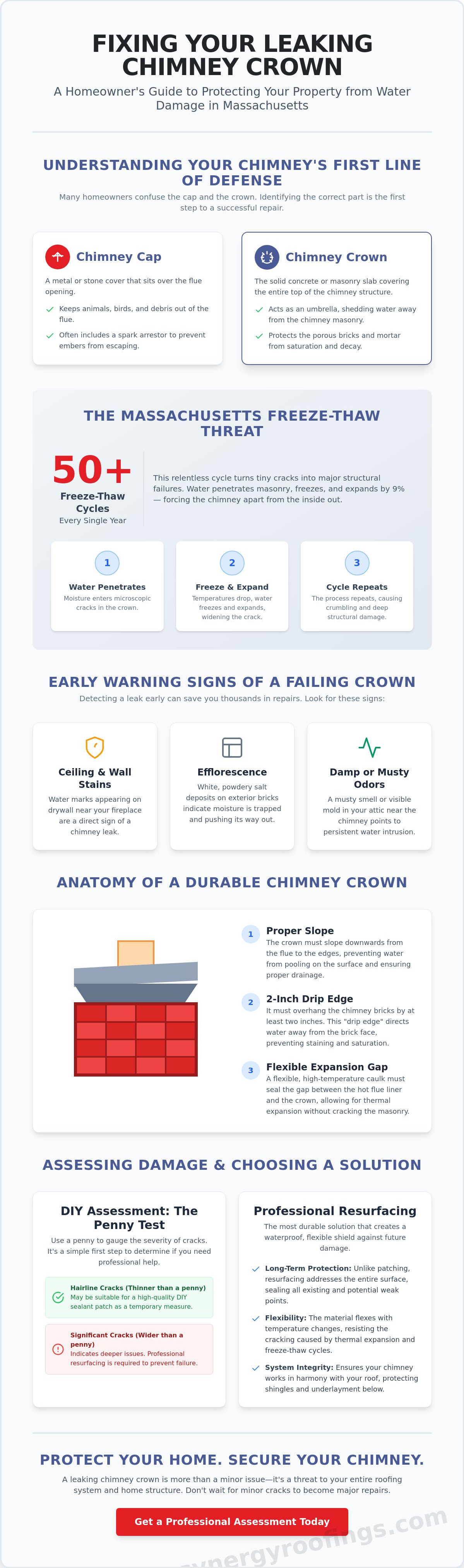
The chimney crown is the solid concrete or masonry slab that covers the top of your chimney to shed water. It serves as the first line of defense against moisture for your home’s entire exhaust system. By acting as a protective umbrella for the bricks and mortar below, it prevents rain and snow from falling directly into the porous masonry structure. Without this barrier, your chimney becomes vulnerable to internal rot and structural instability.
Many homeowners confuse the chimney crown with the chimney cap, but they serve different functions. The cap is the metal or stone cover that protects the flue opening from debris and animals. In contrast, the crown is the wide base that covers the entire top surface of the chimney. Understanding this distinction is essential when you’re fixing a leaking chimney crown, because a perfectly good cap won’t stop water from entering through a cracked crown. Gaining a deeper perspective on the Chimney structure and function helps clarify how these components work together to protect your home.
To better understand this concept, watch this helpful video:
When a crown fails, it exposes the core of your chimney. Masonry is naturally porous, meaning it acts like a sponge when it isn’t shielded. Once water penetrates the crown, it travels down into the bricks and mortar, causing them to swell, crack, and eventually crumble. This process doesn’t just damage the chimney; it threatens the shingles and underlayment that make up your residential roofing system.
Common Symptoms of a Leaking Chimney Crown
Detecting a leak early can save you thousands in masonry repairs. Look for these warning signs around your fireplace and attic space:
- Ceiling and Wall Stains: Water marks appearing on the drywall near your fireplace or in the rooms directly below the chimney.
- Efflorescence: White, powdery salt deposits on the exterior bricks, which indicate that water is pushing through the masonry.
- Damp Odors: A musty smell or visible mold growth in the attic space where the chimney passes through the roof.
Anatomy of a Properly Constructed Crown
A durable design is the key to successfully fixing a leaking chimney crown for the long term. A high-quality crown requires specific engineering features to remain effective:
- The Drip Edge: The crown should overhang the chimney bricks by at least two inches. This drip edge ensures that water falls directly to the roof rather than running down the face of the bricks.
- Proper Slope: A well-designed crown slopes downward from the flue to the edges, preventing water from pooling on the surface.
- The Expansion Gap: Because the clay flue liner expands when it gets hot, there must be a small gap between the flue and the crown. This gap is typically sealed with a flexible high-temperature caulk to allow movement without cracking the masonry.
Why Chimney Crowns Fail: The Massachusetts Freeze-Thaw Factor
Massachusetts winters are notoriously hard on masonry. In Norfolk County, we experience frequent temperature swings that drive the freeze-thaw cycle. When moisture enters a tiny fissure in your chimney, it stays there. Once the temperature drops below 32 degrees, that water expands by approximately 9% in volume. This expansion acts like a slow-motion explosion inside the masonry, pushing the concrete apart from the inside out. Over a single winter, this process can turn a microscopic gap into a major structural problem.
Thermal expansion adds another layer of stress. When you light a fire, the clay flue liner inside your chimney heats up rapidly and expands. If the crown was built too tightly against the flue without a proper expansion joint, that outward pressure will crack the surrounding masonry. This creates a cycle where heat-induced cracks allow more water in, which then freezes and widens the gap further. Understanding these physical forces is the first step toward fixing a leaking chimney crown effectively.
Local environmental factors like acid rain and heavy snow loads shouldn’t be ignored. Acidic precipitation slowly dissolves the calcium and lime that hold masonry together. Meanwhile, heavy snow can sit on a flat crown for weeks, providing a constant source of moisture that keeps the material saturated and vulnerable to the next cold snap.
The Danger of the ‘Mortar Wash’
Many builders take a shortcut called a mortar wash. Instead of pouring a thick, reinforced concrete slab, they simply smear a thin layer of leftover mortar over the top of the bricks. Mortar is designed to be a bonding agent, not a waterproof roof. It lacks the structural integrity to withstand New England weather and typically begins to flake and peel within five years. If your crown looks like a thin, beveled edge of grey paste rather than a substantial concrete block, it’s likely a mortar wash destined for failure.
Structural Shifts and Settlement
Your chimney is one of the heaviest parts of your home. Even minor foundation settling can cause the chimney to tilt or shift slightly. Because the crown is the highest point, it often bears the brunt of these structural movements, resulting in deep, vertical fractures. Poor gutter drainage is a frequent culprit here, as water pooling at the base of your home can soften the soil and lead to chimney instability. A leaking crown is often a symptom of larger structural stresses. If you notice signs of moisture intrusion, a professional roof leak repair inspection can help determine if the issue is isolated or part of a broader roofing system failure.
Assessing the Damage: DIY Patching vs. Professional Resurfacing
Before you commit to a repair method, you must determine the true extent of the damage. A small fissure might seem like a minor cosmetic issue, but in the context of New England weather, it is a direct pathway for structural decay. We suggest using the “Penny Test” as your first diagnostic step. Try to slide a penny into any visible cracks on the crown. If the coin fits, the gap is already wide enough to allow significant water penetration, which will fuel the destructive freeze-thaw cycles we previously explored. Cracks of this size require more than just a quick surface sealer to protect your home.
Evaluating structural integrity means looking for signs of separation. If the concrete slab is still firmly bonded to the chimney bricks, you might be dealing with surface-level weathering. However, if the crown is starting to lift or “float” away from the masonry, the internal bond has failed. When you consider the long-term ROI, the choice becomes clear. Spending a small amount on a professional repair now is a strategic move to avoid a full masonry rebuild that can cost $5,000 or more. In Medway and across Norfolk County, many homes feature high-pitch roofs that make these inspections particularly hazardous. Your safety is paramount; don’t risk a fall when a professional can provide a secure, ground-up assessment of your chimney’s health.
When DIY Patching is an Option
You can often handle minor maintenance yourself if the damage is limited to hairline cracks. If no crack exceeds 1/8 inch in width, a high-quality elastomeric sealant can provide a reliable barrier. These products are designed to remain flexible, stretching and contracting as the temperature fluctuates. While a DIY approach works for fixing a leaking chimney crown with minor wear, these are often temporary measures. They are excellent for emergency fixes during a storm to stop active moisture from reaching your ceiling, but they don’t address underlying structural shifts.
Signs You Need Professional Chimney Crown Resurfacing
Professional intervention is necessary when the crown’s structural foundation is compromised. If you see deep cracks extending through the entire thickness of the concrete or notice missing chunks of masonry, a simple patch won’t suffice. Resurfacing involves applying a reinforced, high-strength fiber coating that restores the crown’s original shedding ability. We frequently find that these issues are linked to problems where the chimney meets the roofline. In these cases, a comprehensive roof leak repair is the only way to ensure your shingles and underlayment remain protected from secondary water damage.
The Professional Repair Process: How to Fix it Right
When we handle the task of fixing a leaking chimney crown, our focus is on creating a permanent barrier rather than a temporary patch. A professional repair is a multi-layered process designed to address both visible damage and the invisible weaknesses that lead to future failures. We approach every project with the goal of restoring your peace of mind by ensuring your chimney can withstand the harshest New England seasons. By following a logical, expert-led sequence, we transform a crumbling surface into a durable shield for your home.
Step 1: Surface Preparation and Cleaning
We begin by stripping away the elements that prevent a secure bond. While it’s tempting to use a pressure washer, we generally avoid this for damaged crowns. High-pressure water can force moisture deep into existing cracks, causing more harm than good. Instead, we use a stiff wire brush to remove moss, soot, and loose debris. This mechanical cleaning creates a textured surface that allows new materials to grip the old masonry effectively. The surface must be completely dry before we apply any waterproof coatings to prevent trapping moisture inside the structure, which would only lead to internal rot later.
Step 2: Reinforcing and Resurfacing
For crowns with deep fractures, we use high-strength masonry cement to fill voids and restore structural volume. In cases where the damage is extensive, we integrate a reinforcing mesh to provide an internal skeleton for the new layer. This prevents future shifting from reopening the cracks. We then apply a flexible, fiber-reinforced membrane, often referred to as the ‘Crown Seal’ method. This material remains elastic through extreme temperature changes, stretching as the chimney moves. We carefully shape this layer into a sloped finish to ensure water run-off is directed away from the flue. Using UV-resistant materials is vital here, as the sun’s rays can degrade standard concrete over time.
Step 3: Flashing and Sealant Integration
A crown repair is only as strong as its weakest joint. We pay special attention to the area where the flue liner meets the crown. We seal this juncture with high-temperature silicone caulk, which allows the flue to expand safely without cracking the new surface. We also perform a critical check on your chimney flashing to ensure the metal transition to your roof is watertight. If these components aren’t working in harmony, the crown repair won’t be effective. Our final step is a water-slope test to verify that moisture sheds exactly where it should, protecting your shingles and masonry. If you suspect your chimney is letting moisture into your home, we can provide a definitive solution. Schedule a professional roof leak repair assessment today to safeguard your masonry and restore your home’s integrity.
Total Roof Protection: Why Your Chimney Crown is Part of a System
Your chimney doesn’t exist in isolation. It’s a critical structural penetration that must be perfectly integrated with your shingles and underlayment to prevent moisture from compromising your home’s interior. When we approach fixing a leaking chimney crown, we look beyond the concrete slab to evaluate the entire roofing ecosystem. Water follows the path of least resistance, and a failure at the very top of your chimney can quickly become a failure in your attic, your ceilings, and your structural framing. This holistic view is what ensures a repair lasts for decades rather than just a few seasons.
The Chimney-Roof Juncture
Water that sheds off a cracked or poorly sloped crown doesn’t just disappear. If the crown isn’t doing its job, heavy rain often flows directly onto the chimney flashing or pools against the surrounding shingles. This constant moisture exposure can lead to rotted roof decking near the chimney base, a problem that often stays hidden until the wood becomes soft and structurally unsound. We frequently find that flashing fails at the same time as the crown because both components face the same brutal Massachusetts weather. A professional ‘Roof Health Check’ after a harsh winter is a proactive way to identify these vulnerabilities. It’s much easier to address a minor seal issue than it is to replace large sections of rotted plywood and water-damaged insulation.
Maintaining a watertight exterior is also a prerequisite for other home upgrades. If you are planning a skylight installation, your roof must be in peak condition to support the new hardware and maintain a leak-free seal. Every penetration, from the chimney to the sun tunnels, relies on the integrity of the surrounding materials to keep your home dry and secure.
Protecting Your Investment with Synergy Roofing
We’re dedicated to serving our neighbors in Medway and across Norfolk County with a commitment to quality that goes beyond the surface. We prioritize long-term reliability because we understand that your home is your most significant priority. By using high-strength, UV-resistant materials and expert bonding techniques, we ensure that fixing a leaking chimney crown provides the psychological relief you deserve. Our team acts as a protective partner, guiding you through the technical choices to find the most straightforward, high-quality solution for your property. We take pride in our practical foundations and our ability to renew even the most weathered structures.
Protect your home today—request a professional chimney and roof inspection from Synergy Roofing.
Secure Your Home’s Future with a Watertight Chimney
Protecting your home from the relentless New England weather requires a proactive mindset. Your chimney crown acts as a critical shield, and when it fails, the moisture damage quickly spreads to your shingles and structural decking. By understanding the physics of the freeze-thaw cycle and the importance of a professional resurfacing process, you can avoid the stress of a full masonry rebuild. Fixing a leaking chimney crown isn’t just a simple maintenance task; it’s a vital investment in the safety and longevity of your entire property.
At Synergy Roofing, we bring over 25 years of experience to every project in Medway and throughout Norfolk County. Whether you need expert chimney flashing repair or you’re looking for Velux skylight specialists to enhance your home, our team provides the reliable solutions you need. We treat your property as a complete system, ensuring every transition and joint is secure against the elements. Schedule Your Professional Roof & Chimney Inspection today to gain the psychological relief that comes with a job done right. We’re ready to help you safeguard what matters most with the quiet confidence of specialized expertise.
Frequently Asked Questions
How do I know if my chimney leak is coming from the crown or the flashing?
The location of the water stains is the most reliable indicator of the source. Crown leaks typically cause water to drip directly into the firebox or create stains on the ceiling immediately surrounding the chimney. Flashing leaks often manifest as water running down the bricks in your attic or stains on the ceiling several feet away from the chimney where the roof slope carries the runoff.
Can I use regular cement to fix a chimney crown crack?
No, regular cement lacks the necessary flexibility to withstand New England’s temperature swings. Standard concrete is rigid and will inevitably crack again during the next freeze-thaw cycle. You need a specialized, fiber-reinforced elastomeric sealant that expands and contracts with the flue’s heat to ensure you are effectively fixing a leaking chimney crown for the long term.
How much does it typically cost to repair a chimney crown in Massachusetts?
Repair costs vary significantly based on the height of your roof, the severity of the cracks, and current Massachusetts building codes. A simple sealing of hairline fractures is a different investment than a full structural resurfacing. We recommend a professional inspection to provide an accurate assessment that considers the specific masonry needs and safety requirements of your Norfolk County home.
How long does a professional chimney crown repair last?
A high-quality professional resurfacing typically lasts between 15 and 20 years. This longevity depends on the use of UV-resistant, flexible membranes rather than the thin mortar washes often found on older homes. Keeping the crown clear of moss and debris will help maintain the integrity of the waterproof barrier and protect the underlying bricks from moisture penetration.
What happens if I ignore a leaking chimney crown?
Ignoring a leak leads to the total structural failure of your chimney over time. Water saturates the porous bricks, causing them to expand and crumble during winter freezes. This moisture eventually rots the roof decking and attic joists, turning a straightforward repair into a massive reconstruction project that threatens the safety and value of your entire property.
Is it better to repair or replace a damaged chimney crown?
Most crowns are candidates for resurfacing if the base masonry is still structurally sound. If the concrete is missing large chunks or the chimney itself has started to tilt, a full replacement is the only safe option. A professional can determine if the internal bond is strong enough to support a new membrane or if the structure requires a complete rebuild.
Do I need a chimney cap if my crown is in good condition?
Yes, a chimney cap is essential regardless of how perfect your crown looks. While the crown protects the top surface of the masonry, the cap prevents rain, snow, and pests from entering the open flue. Both components work together as a system to keep water out of your home’s interior and prevent internal flue damage.
Can a leaking chimney crown cause an attic fire?
Yes, a leaking crown can create a significant fire hazard by damaging the chimney’s internal components. Chronic moisture intrusion often causes the clay flue liner to crack or shift. If the liner is compromised, heat and sparks from your fireplace can escape into the attic space or against wooden framing members, potentially igniting a fire behind your walls.