
A flashy website and a five-star rating don’t protect your home from a Nor’easter; only a valid Home Improvement Contractor registration and a strict commitment to Massachusetts building codes can do that. You’re likely feeling the weight of this decision, especially when “fly-by-night” contractors make it hard to tell a true expert from a salesperson with a truck. Finding a trustworthy roofer near me shouldn’t feel like a gamble with your property’s safety or your hard-earned savings.
We understand the stress that comes with conflicting estimates and the lingering fear of future leaks. You deserve a partner who views your roof as a long-term investment, not just a one-day job. In this guide, you’ll learn the exact framework for identifying reliable local roofing professionals while avoiding common industry scams and red flags. We’ll preview the essential 2026 vetting checklist, explain why technical transparency is non-negotiable, and show you how to secure a roof that protects your family for 30 years or more.
Key Takeaways
- Verify active Massachusetts CSL and HIC registrations to ensure your contractor is a legitimate local professional instead of an out of state storm chaser.
- Discover why finding a trustworthy roofer near me requires a partner who understands Norfolk County building codes and the specific ventilation needs of New England homes.
- Spot the red flags of high pressure sales tactics and learn to recognize the value of a transparent, detailed project estimate.
- Master the essential paperwork requirements, from mandatory insurance certificates to the critical differences between material and labor warranties.
- Learn how specialized expertise in residential roofing and Velux systems provides long term protection and psychological relief for your property.
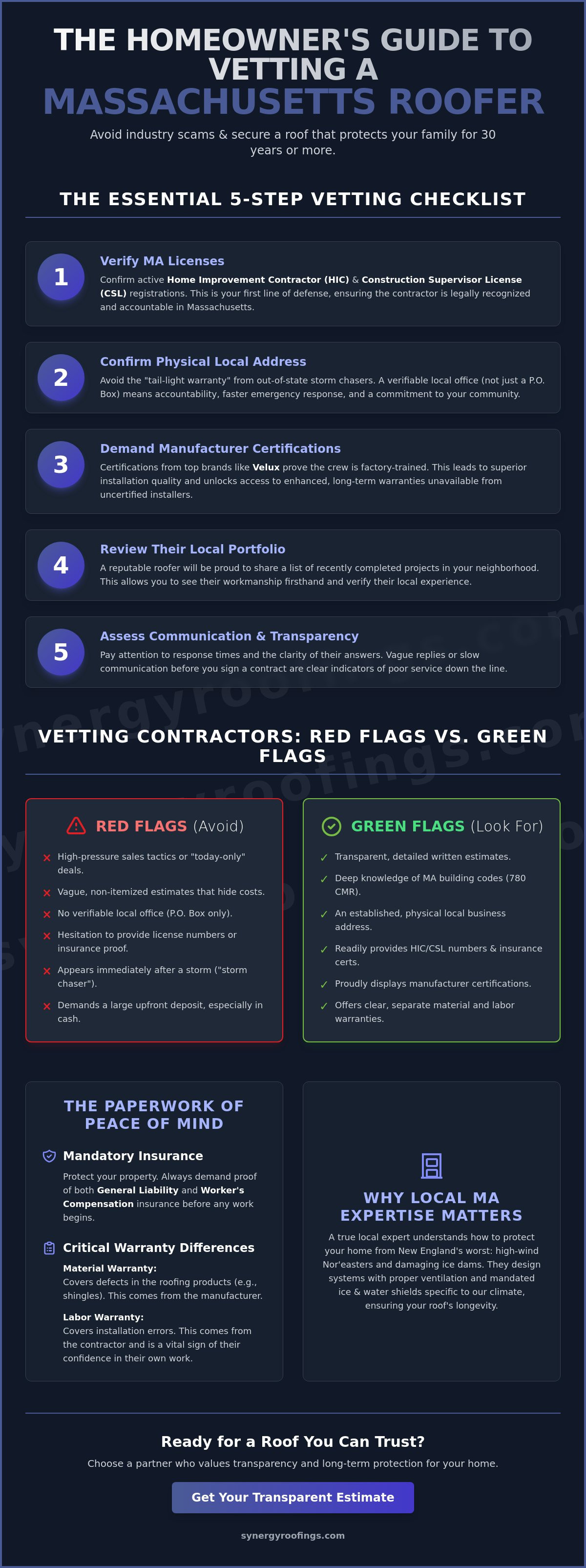
The 5-Step Checklist for Finding a Trustworthy Roofer Near You
Identifying a contractor who actually cares about your home requires looking past a polished sales pitch. Finding a trustworthy roofer near me starts with verifying their physical presence in the community. You want a partner who has deep roots in Massachusetts, not a transient team following the latest hailstorm. Start by confirming their local office address and checking for active state-specific licensing before you discuss any project details.
In Massachusetts, any legitimate contractor must possess a Home Improvement Contractor (HIC) registration for existing residential work. If your project involves structural changes, they also need a Construction Supervisor License (CSL). Before signing a contract, ask for these numbers and verify them through the state’s online database. This step ensures you’re protected by the state’s consumer protection laws and that the professional has met the necessary legal requirements to operate.
To better understand how these factors influence your final decision, watch this helpful video:
Why a Physical Local Address Matters
The “tail-light warranty” is a common industry risk where a contractor’s guarantee disappears as soon as their truck pulls out of your driveway. By choosing a company with a verified local office, you gain the security of knowing where to find them if an issue arises. You can verify a business address using Google Maps street view or local town tax records to ensure it’s a real place of business and not just a P.O. box. A local presence also means faster response times for emergency roof leak repair, which is vital during our unpredictable New England winters.
Manufacturer Certifications as a Trust Signal
Technical mastery is just as important as legal compliance. Look for manufacturers’ certifications from brands like Velux or major shingle providers. These designations aren’t just badges; they prove the crew has undergone factory training to meet specific installation standards. This specialized knowledge is critical for understanding roof basics like proper ventilation and flashing. Manufacturer-backed training is the gold standard for roofing in 2026 because it often allows the contractor to offer extended warranties that uncertified roofers simply cannot provide.
Finally, analyze their local portfolio in towns like Medway or Littleton. A trustworthy roofer will proudly show you completed projects in your neighborhood. Pay close attention to their communication speed during your initial inquiry. If they’re slow to respond or vague about their process before you’ve paid them, it’s a clear sign that transparency will vanish once the job begins. At Synergy Roofing, we believe that clear, honest communication is the foundation of every successful project.
Why Local Massachusetts Expertise is a Non-Negotiable Trust Factor
National franchises often miss the nuances of New England architecture and our unforgiving climate. Whether you own a historic Colonial in Medway or a modern commercial structure, your roof must be engineered for a very specific environment. Finding a trustworthy roofer near me means looking for a partner who treats your home like a protective barrier against high-wind Nor’easters and heavy snow loads. Local knowledge isn’t just a bonus; it’s the foundation of a roof that lasts 30 years or more.
Protecting Against the New England Winter
Ice dams are a recurring nightmare for homeowners across Norfolk County. A local expert doesn’t just install shingles. They design a comprehensive system that includes proper attic ventilation and specialized underlayment to stop water from backing up under your shingles. The Massachusetts State Building Code (780 CMR) mandates the use of an ice and water shield on all eave edges to prevent this exact issue. If your current roof is already showing signs of distress after a heavy winter, our roof leak repair resource provides a clear roadmap for restoring your home’s security.
Navigating Local Norfolk County Regulations
Building codes aren’t just red tape; they’re essential safety standards that vary by municipality. A sign of a truly professional business is their insistence on pulling the necessary permits for every project. In Norfolk County, this ensures your roof passes inspection and remains compliant with regional laws. If a contractor asks you to pull the permit yourself, it’s a major red flag. It often means they’re unlicensed or trying to shift the legal burden onto you. Local professionals maintain steady relationships with building inspectors, which helps keep your project moving forward without administrative delays.
When you’re evaluating candidates, check if they align with the Better Business Bureau’s roofing contractor tips regarding local reliability. This expertise ensures your home isn’t just another job on a list, but a priority for someone who understands our local community. If you’re ready to secure your property with a solution built for the Massachusetts landscape, reaching out to a local specialist is the most reliable way to gain peace of mind before the next storm hits.
Red Flags vs. Green Flags: Vetting Contractors During the Estimate
The estimate process is more than a price reveal; it’s a job interview for your home’s security. Finding a trustworthy roofer near me involves observing how a professional conducts their initial assessment. A true expert won’t just stand on the lawn and point. They’ll perform a thorough inspection that includes taking photos of your attic and roof deck to identify underlying structural issues that aren’t visible from the ground.
Look for contractors who explain the “why” behind their recommendations. If they suggest a full replacement over a minor repair, they should provide photographic evidence of shingle failure, moisture intrusion, or deck rot. Conversely, be wary of high-pressure sales tactics. “Today-only” discounts or limited-time offers are designed to bypass your logical vetting process. Trustworthy partners give you the space to make a calculated decision for your property without feeling rushed into a contract.
The Anatomy of a Professional Roofing Quote
A vague “lump sum” quote is a recipe for hidden costs and project delays. A professional estimate should be a detailed line-item breakdown. It must specify the type of shingles, the brand of flashing, the ventilation strategy, and any necessary work on skylights or sun tunnels. This level of detail is a hallmark of choosing the best roofers in Massachusetts. It ensures both parties are on the same page regarding the scope of work before a single nail is driven.
Evaluating Non-Verbal Professionalism
Professionalism extends to the equipment and behavior you see on your driveway. Does the contractor arrive in a branded vehicle? Are they wearing proper safety gear? While drones are useful for initial measurements, a roofer who actually climbs onto the roof shows a commitment to physical inspection that technology can’t fully replace. They need to feel the soft spots in the plywood and check the integrity of the chimney flashing firsthand.
Ask direct questions about their crew. You want to know if they use their own employees or sub-contractors. A reliable partner will be transparent about their labor policies and their safety record. Finally, never agree to a large cash deposit. Requesting more than one-third of the total project cost before any materials arrive on-site is a significant red flag that often points to financial instability. Your journey toward finding a trustworthy roofer near me concludes when you find an expert who values clarity and safety as much as you do.
The Paperwork of Peace of Mind: Insurance and Warranties
The final step in finding a trustworthy roofer near me involves moving beyond verbal promises and into the world of legal documentation. While a contractor’s portfolio shows you their past results, their paperwork tells you how they handle the unexpected. In Massachusetts, this begins with verifying their state-mandated credentials. A legitimate roofing professional must maintain a Home Improvement Contractor (HIC) registration for residential work and a Construction Supervisor License (CSL) if the project involves structural changes. These licenses are the baseline, but insurance and warranties provide the actual financial safety net for your home’s equity.
Why General Liability Isn’t Enough
Many homeowners mistakenly believe that general liability insurance is a catch-all for any project mishap. While liability coverage handles damage to your property, such as a fallen limb hitting your siding, it does not protect you from personal injury claims. If a crew member is injured on your property and the contractor does not carry active Workers’ Compensation insurance, you could be held legally and financially responsible for their medical bills. A trustworthy roofer carries insurance that protects the homeowner’s equity by shifting all professional risk away from the client.
Do not simply take a contractor’s word that they are covered. Request a Certificate of Insurance (COI) and ask that it be sent directly to you from their insurance agent. This ensures the policy is active and hasn’t lapsed due to non-payment. This level of transparency is a non-negotiable standard for any professional business operating in 2026.
Labor vs. Material Warranties
Understanding the difference between these two protections is vital because most roof failures are caused by human error, not faulty products. A manufacturer’s material warranty covers the shingles or rubber membranes themselves. However, if a leak occurs because of poor flashing or improper ventilation, the material warranty will likely be voided. This is why a contractor’s labor warranty is your most important shield. It covers the actual installation process and the skill of the crew.
Be wary of the term “Lifetime Warranty” without reading the fine print. Many of these offers are pro-rated, meaning they lose value every year the roof ages. For a detailed breakdown of how these protections apply to specific products, refer to our asphalt shingle roofing guide. Specialized systems, such as rubber roofing or metal panels, often require unique warranty structures due to their specific installation demands. If you want to ensure your property is fully protected by a team that carries comprehensive coverage and stands behind every nail, contact Synergy Roofing today to review our professional credentials and project safeguards.
Why Synergy Roofing is the Trusted Choice for Medway Homeowners
Finding a trustworthy roofer near me is more than a simple checklist; it’s about identifying a partner who values your home’s integrity as much as you do. After navigating the complexities of licensing, insurance, and estimates, the final decision comes down to reliability and proven results. At Synergy Roofing, we’ve built our reputation on the practical foundations of honesty and community. We ensure that every project leads you from a state of concern to total resolution with a roof built to last.
Our team doesn’t just install shingles. We provide a comprehensive environmental shield tailored to the specific needs of Medway and the surrounding Norfolk County. By combining technical weight with an approachable demeanor, we make the administrative and technical choices of a roof replacement easy to digest. We believe the best results are achieved through a collaborative relationship between our experts, our high-quality resources, and you.
A Local Track Record You Can Verify
Synergy Roofing has deep roots in the Massachusetts area, serving local homeowners since 2000. This longevity is a testament to our commitment to quality and our refusal to use the “fly-by-night” tactics that often plague the industry. Finding a trustworthy roofer near me is about more than just reading reviews; it’s about seeing a consistent history of excellence in your own neighborhood. Our expertise spans a wide range of essential services, including:
- Residential Asphalt Shingle Roofing with wind resistance up to 130 mph
- Durable Rubber and Metal Roofing systems for varied architectural needs
- Precision Velux Skylight Installation and replacement
- Sun Tunnel installation and expert chimney flashing
- Gutter installation and low-pitch roofing solutions
We encourage you to view our local project galleries. Seeing our work on homes in your community provides the psychological relief that comes from knowing your property is in expert hands. Whether it’s a simple roof leak repair or a complex commercial project, our steady rhythm of work ensures transparency at every stage of the process.
The Synergy Protective Partnership
Our brand philosophy is built on the concept of being a protective partner. We don’t just work on a house; we act as a guardian of your environment. This means maintaining a calm, expert demeanor that suggests every problem has a straightforward, high-quality solution. We alleviate the stress of asset maintenance by keeping communication open and honest. You’ll never have to wonder about the next step in your project.
We treat your property like the significant priority it is. By using high-quality materials and adhering to the strictest safety standards, we ensure your new roof offers both aesthetic appeal and decades of security. If you’re ready to move from worry to confidence with a team that values your peace of mind, schedule your professional roof inspection with Synergy Roofing today and experience the difference of a dedicated local expert.
Secure Your Property with a Reliable Partner
Protecting your home starts with a commitment to high standards and local accountability. You’ve learned that finding a trustworthy roofer near me requires more than checking a few stars on a review site; it demands a deep dive into local licensing, manufacturer certifications, and insurance coverage. By prioritizing contractors who pull their own permits and offer transparent, line-item estimates, you ensure that your investment is safeguarded against the unpredictable New England climate. To see how these same standards of quality and transparency apply to other exterior projects like siding and windows, read more.
At Synergy Roofing, we take pride in being a dependable guardian for your environment. We’ve been serving the Massachusetts community since 2000, maintaining full CSL and HIC licensing alongside our status as Velux Certified Specialists. Our team focuses on renewal and safety, providing the psychological relief you deserve when maintaining your most valuable asset. Don’t leave your home’s future to chance when a straightforward, high-quality solution is just a conversation away.
Request Your Free, No-Obligation Roofing Estimate
Take the next step toward a roof that lasts for decades. We’re here to guide you through every technical choice with honesty and expert care.
Frequently Asked Questions
How do I verify a roofing contractor’s license in Massachusetts?
You can verify a license through the Massachusetts ePLACE Portal or the OCABR website. Search for the contractor’s Home Improvement Contractor (HIC) registration and Construction Supervisor License (CSL) to ensure they’re current. Always cross-reference the business name with the license holder to confirm you’re dealing with the authorized entity. This verification process is a simple way to protect your home from unlicensed operators.
Should I hire a roofer who isn’t BBB accredited?
BBB accreditation isn’t a legal requirement, but it indicates a business’s willingness to adhere to specific ethical standards. You don’t necessarily have to avoid non-accredited roofers, but you must be more diligent in checking their state licenses and local references. Finding a trustworthy roofer near me is about looking at the total picture of reliability, including their standing with consumer protection agencies.
What is the difference between a CSL and an HIC license in MA?
An HIC registration allows a contractor to work on existing one-to-four family homes and provides homeowners with access to the state’s Guaranty Fund. A CSL is required for structural work and proves the contractor has passed exams on the state building code. Most professional roofing projects in Massachusetts require a contractor who understands both, as roofing involves both surface materials and structural integrity.
How much of a deposit should a trustworthy roofer ask for?
A professional contractor typically requests a deposit of no more than one-third of the total project cost. This initial payment covers the cost of materials and scheduling. If a contractor asks for 50% or more before any shingles arrive on your property, it’s a sign of financial instability. You should only pay the final balance once the job is completed and inspected.
Can a roofer help with my insurance claim for storm damage?
Roofers can assist by providing a professional inspection report and meeting with your insurance adjuster to point out specific storm damage. They act as technical experts who ensure the adjuster sees the full scope of the repair needs. While they provide the documentation required for your claim, they cannot legally replace the role of a licensed public adjuster in the state of Massachusetts.
What happens if a roofer damages my property during installation?
If property damage occurs, the contractor’s General Liability insurance is designed to cover the repair costs. This is why you must verify their coverage before any work begins on your home. A reliable roofer will take responsibility for the accident and coordinate with their insurance agent to resolve the issue. This protection ensures that your landscaping, windows, and siding remain safe throughout the process.
How many estimates should I get before choosing a roofer?
We recommend obtaining at least three estimates to get a clear picture of the local market. Comparing three quotes helps you identify outliers who may be overcharging or undercutting the competition by skipping essential steps. Look for consistency in the scope of work, including details on ventilation and flashing. This comparison gives you the confidence to make an informed decision for your home.
Why are some roofing quotes so much lower than others?
Extremely low quotes often signal that a contractor is cutting corners on safety, insurance, or material quality. They might be using 3-tab shingles instead of architectural ones or failing to include the cost of building permits. While a lower price is tempting, it often leads to a shorter roof lifespan and a lack of warranty support when you need it most.