
Is your flat roof a strategic asset or a hidden liability waiting for the next Massachusetts heatwave? You likely recognize the frustration of chasing recurring leaks on flat sections or watching cooling costs climb as your building absorbs the summer sun. It’s a common struggle for property owners, but your roof should act as a protective partner for your business, not a source of constant stress. Finding the right commercial rubber roofing metro west ma is about more than just stopping water; it’s about securing a high ROI through modern materials and local expertise.
We understand that you want a leak-proof, energy-efficient solution that complies with the mandatory 10th edition of the Massachusetts State Building Code. You’ll learn exactly how to choose between traditional EPDM and high-performance TPO systems, which offer a proven lifespan of 20 to 30 years. This guide explores the “cool roof” technology that’s currently transforming properties from Medway to Framingham. We will walk you through the technical choices and installation standards that ensure your next roofing project is your last one for decades. By the end, you’ll have a clear path toward a more secure and efficient commercial property.
Key Takeaways
- Understand why modern single-ply membranes are replacing outdated tar and gravel systems to provide superior protection for local businesses.
- Discover how TPO roofing remains flexible during extreme Massachusetts temperature swings to prevent cracks and leaks.
- Compare the long-term maintenance requirements and life expectancy of EPDM versus TPO to maximize your building’s ROI.
- Learn the critical technical standards for commercial rubber roofing metro west ma, from proper R-value insulation to substrate preparation.
- Identify the benefits of working with a Medway-based team that specializes in both flat roof durability and Velux skylight integration.
Understanding Commercial Rubber and TPO Roofing in Metro West, MA
Choosing the right roof for your property is a significant decision that impacts your building’s safety and your long-term maintenance budget. In the past, many property owners relied on multi-layer tar and gravel roofs. Today, the industry has shifted toward single-ply Membrane roofing because these systems offer superior leak protection and simplified maintenance. When we talk about commercial rubber roofing metro west ma, we’re usually referring to two primary materials: EPDM (ethylene propylene diene monomer) and TPO (thermoplastic polyolefin).
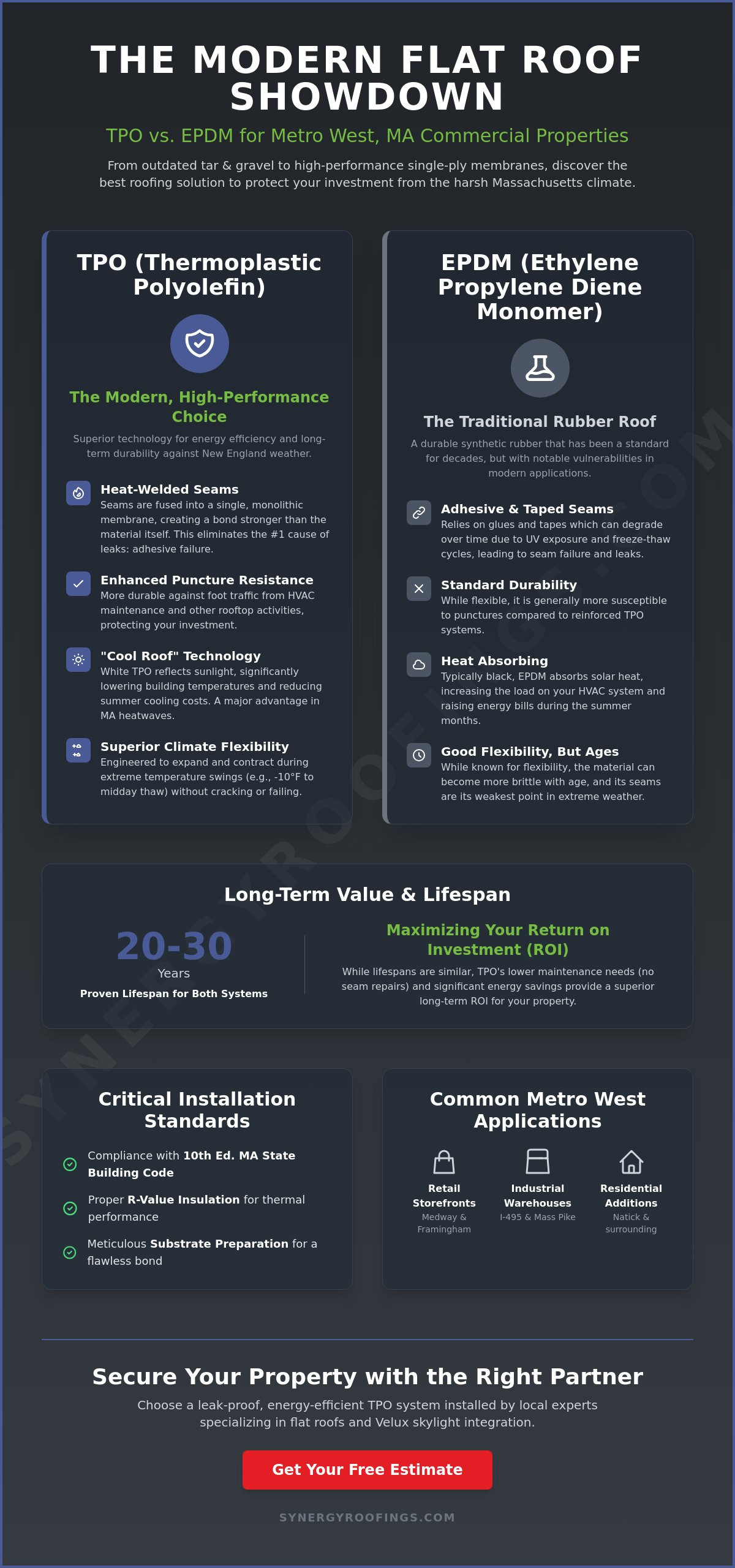
Traditional EPDM is a durable, black synthetic rubber that’s protected New England buildings for decades. However, many Metro West businesses are now opting for white TPO membranes. While EPDM typically relies on adhesives or tapes to secure its seams, TPO seams are fused together using high-heat welding. This creates a monolithic surface that’s significantly more resistant to the freeze-thaw cycles common in Massachusetts. This shift isn’t just about color; it’s about how the material handles the physical stress of our volatile climate.
To better understand the potential challenges and benefits of traditional rubber systems, watch this helpful video:
The Evolution of Flat Roofing Membranes
The transition from traditional EPDM to modern TPO represents a major leap in commercial durability. While EPDM is known for its flexibility, TPO offers enhanced puncture resistance. This is vital if your roof houses HVAC units that require regular servicing by technicians walking across the surface. Heat-welding is the real game-changer here. By melting the membrane edges together, we create a bond that’s actually stronger than the material itself. This process eliminates the risk of adhesive failure, which is the leading cause of leaks in older flat roofs as they age.
Common Applications in the Metro West Corridor
We see these systems applied across a variety of property types throughout our local communities. Retail storefronts in the Medway and Framingham downtown areas often utilize TPO to reflect sunlight and keep cooling costs manageable for tenants. Along the I-495 and Mass Pike routes, industrial warehouses rely on the heavy-duty protection of commercial rubber roofing metro west ma to safeguard valuable inventory. Even in Natick, residential owners with modern flat-roof additions or low-slope sections are choosing these professional-grade membranes over traditional shingles to ensure a leak-proof seal. If you’re looking for a local partner to evaluate your specific structure, the team at Synergy Roofing can help you determine which membrane fits your building’s footprint and traffic needs.
Why TPO is the Superior Choice for the Massachusetts Climate
The weather in the Metro West corridor is notoriously unforgiving. On a typical January night, temperatures can plummet to -10°F, only to be followed by a rapid midday thaw. This cycle creates intense mechanical stress on any flat roof. For many property owners, the search for commercial rubber roofing metro west ma ends with TPO (Thermoplastic Polyolefin) because of how it handles these extreme shifts. While traditional materials might become brittle or see their seams pull apart, TPO remains remarkably flexible. It’s designed to expand and contract without cracking, acting as a resilient shield for your building’s infrastructure.
Snow load management is another critical factor for commercial properties in Norfolk County. When heavy snow sits on a flat surface, it doesn’t just add weight; it creates a risk for ice damming if the roof’s thermal performance is poor. TPO systems, when installed with high-quality insulation, help maintain consistent surface temperatures. This encourages proper drainage and prevents the standing water that often leads to structural damage during a long New England winter. If you’re concerned about how your current roof is handling the weight of the season, a quick inspection from the team at Synergy Roofing can provide the peace of mind you need.
Seam Integrity and Freeze-Thaw Resilience
In our high-humidity environment, adhesive-based seams are often the first point of failure. Moisture can weaken the chemical bond over time, leading to gaps that allow water to penetrate during the freeze-thaw cycle. TPO solves this through the physics of heat-welding. By fusing the sheets together, we create a monolithic waterproof barrier. This heat-welded bond is physically stronger than the membrane itself, ensuring that the seams won’t peel or leak even when subjected to the expansion of freezing water. It’s a straightforward, high-quality solution to a complex environmental problem.
Energy Efficiency and Solar Reflectance
While winters are harsh, Massachusetts summers bring high humidity and intense sun. This is where the “Cool Roof” advantage becomes a financial asset. White TPO membranes are designed to reflect up to 80% of solar radiation back into the atmosphere. By choosing Energy-Efficient Cool Roof Products, you can significantly lower your building’s internal temperature. In 2026, this translates to lower cooling costs and reduced strain on your HVAC systems. While some federal tax credits expired at the end of 2025, local Mass Save programs still offer rebates for weatherization and insulation improvements. When you combine these energy-efficient materials with professional installation, the ROI on your investment becomes clear through both reduced maintenance and lower monthly utility bills.
TPO vs. EPDM Rubber: Which System Wins for Your Building?
When you’re evaluating options for commercial rubber roofing metro west ma, you’ll likely hear the terms “rubber” and “TPO” used interchangeably. It’s a common source of confusion for property owners. EPDM is the traditional black synthetic rubber that’s been a staple for decades, while TPO is the modern thermoplastic membrane we’ve discussed for its heat-welded seams. Both materials offer a verified lifespan of 20 to 30 years in the New England climate, but the “winner” for your specific building depends on your operational needs and environmental exposure.
For Metro West restaurants and food service facilities, TPO often takes the lead because it’s inherently resistant to animal fats and grease. Traditional EPDM can soften and swell when exposed to kitchen exhaust or oils, leading to premature failure around vent stacks. TPO also resists mold and algae growth more effectively than its black rubber counterpart. However, EPDM remains a reliable choice for small-scale repairs or non-conditioned storage spaces where heat reflection isn’t a primary concern. If you’re also considering options for residential structures, you might find our The 2026 Homeowner’s Guide to Metal Roofing in Massachusetts helpful for steep-slope sections.
The Performance Breakdown
To help you visualize the technical differences, we’ve compared the key performance metrics of these two single-ply systems. While EPDM is a thermoset material that requires chemical adhesives, TPO is thermoplastic, allowing for the superior seam strength we’ve highlighted.
| Feature | EPDM (Traditional Rubber) | TPO (Modern Membrane) |
|---|---|---|
| Seam Strength | Adhesive/Tape (Moderate) | Heat-Welded (Superior) |
| Chemical Resistance | Low (Sensitive to oils/grease) | High (Resistant to fats/grease) |
| UV Resistance | Good (Absorbs heat) | Excellent (Reflects heat) |
| Puncture Protection | Moderate | High (Reinforced fabric) |
Choosing Based on Building Use
Your building’s footprint and location in Metro West should dictate your material choice. Large commercial warehouses with high HVAC costs almost always benefit from TPO’s reflective properties. The energy savings over a 20-year period often outweigh the initial investment differences. Conversely, if your building is located in a historic district where a white roof might clash with neighboring slate or dark shingles, black EPDM offers a more traditional aesthetic that blends into the skyline. Repairs on aged EPDM are generally straightforward using specialized tapes, whereas aged TPO requires careful surface preparation before a new weld can be applied. We recommend a professional assessment to determine which commercial rubber roofing metro west ma system aligns with your building’s long-term maintenance strategy.
Professional Installation: What to Expect from a Metro West Contractor
A high-quality membrane is only the first step toward a secure building. The real longevity of your investment depends on the precision of the installation process. When you’re sourcing commercial rubber roofing metro west ma, you’re hiring a team to build a custom-engineered barrier. This starts with meticulous substrate preparation. We don’t simply lay material over an existing surface; we ensure the structural deck is sound and the insulation provides the necessary R-value to meet the 10th edition of the Massachusetts State Building Code. Proper insulation doesn’t just lower energy bills; it provides a flat, stable surface that prevents the membrane from stretching or sagging over time.
You’ll also need to decide on the attachment method. Fully adhered systems use specialized adhesives to bond the membrane directly to the cover board, offering superior wind uplift resistance and a smooth, aesthetic finish. Mechanically attached systems, which use heavy-duty screws and plates, are often a more cost-effective choice for large industrial warehouses. Regardless of the method, the most critical areas are the roof penetrations. Professional flashing around HVAC units, pipes, and drains is what separates a long-term solution from a temporary fix. If your current system is already showing signs of failure at these points, you may want to review our guide on Roof Leak Repair in Massachusetts to understand your immediate options.
The 5-Step TPO/Rubber Installation Process
- Step 1: Tear-off and Inspection. We remove old materials down to the deck to identify any structural rot or damage that could compromise the new system.
- Step 2: Insulation Installation. High-density insulation or cover boards are installed to provide thermal protection and a rigid substrate.
- Step 3: Membrane Placement. The TPO or EPDM sheets are laid out and allowed to “relax” to prevent wrinkles and tension after attachment.
- Step 4: Robotic Heat-Welding. For TPO systems, we use robotic welders to fuse the primary seams at precise temperatures, ensuring a consistent, monolithic bond.
- Step 5: Hand-Welding and Detailing. Our experts hand-weld complex corners and detail all penetrations, including vents and skylights, for a 100% waterproof seal.
Navigating Local Building Codes and Permits
Every municipality in Metro West has its own specific requirements. We regularly work with building departments in Medway, Millis, and Holliston to ensure every project is fully permitted and compliant with local standards. This includes strict adherence to OSHA safety protocols for commercial job sites, protecting both our workers and your liability as a property owner. As of July 1, 2025, all permit applications must follow the 10th edition of the state building code, which emphasizes higher energy efficiency and stricter structural requirements. We handle these administrative complexities so you don’t have to. If you’re ready to upgrade your facility with a team that understands these local nuances, contact Synergy Roofing for a detailed project consultation.
Synergy Roofing: Metro West’s Flat Roof and Skylight Experts
Your commercial property is one of your most significant priorities. At Synergy Roofing, we don’t view ourselves as just another service provider. We act as your protective partner, ensuring that your investment remains secure against the unpredictable New England elements. Based in Medway, our team brings over 24 years of specialized knowledge to every project. This local accountability means we’re here when you need us, providing the quiet confidence that comes from working with a trusted peer who understands the specific needs of commercial rubber roofing metro west ma. Our 5.0-star rating on Google reflects our commitment to honesty, community, and technical excellence.
What sets us apart is our dual expertise. Many contractors focus solely on the membrane, but we understand that a roof is a complex system of integrated components. We specialize in both high-performance flat roofing and Velux skylight systems. This collaborative approach allows us to address the entire building envelope, ensuring that every transition and penetration is handled with the same high standard of quality. We take pride in our practical foundations while maintaining the sophisticated business standards you expect from a modern partner.
The Advantage of Integrated Skylight Solutions
Skylight flashing is often the primary failure point on flat roofs. When a roofing team doesn’t understand the nuances of skylight integration, the result is often a recurring leak that damages your interior. We eliminate this risk through our specialized Velux Skylight Installation in Medway, MA. By managing both the membrane and the skylight units, we create a seamless, waterproof barrier. This allows you to enhance your commercial interior with natural light without compromising the structural integrity of your roof. It’s a pragmatic solution that delivers both aesthetic appeal and psychological relief for property owners.
Protect Your Investment for 2026
Delaying a necessary roof intervention is a risky gamble. In the Metro West climate, a small leak can quickly evolve into costly structural rot as water infiltrates the deck and insulation. Our team prioritizes renewal and safety, maintaining clean and efficient job sites that respect your business operations. We guide you through the complexities of the 2026 building codes and technical choices, leading you from a state of concern to a state of resolution. If you’re ready to secure your property’s future, Request Your Professional Flat Roof Estimate from Synergy Roofing today. We’re ready to show you why reliability is the foundation of everything we build.
Securing Your Commercial Asset for the Decades Ahead
Your roof is more than just a physical cover; it’s a strategic investment in your property’s long-term efficiency and structural health. We’ve discussed how modern single-ply membranes handle the specific demands of the New England climate, from extreme thermal expansion to the essential benefits of “cool roof” reflectance. Selecting the right material for commercial rubber roofing metro west ma is a vital first step, but the true value lies in the precision of the installation and the reliability of your local partner.
As a locally owned and operated team in Medway, MA, Synergy Roofing provides the quiet confidence you need when managing significant property assets. We are experts in heat-welded TPO and EPDM systems, and as Velux Certified Skylight Specialists, we ensure every penetration in your roof remains watertight. We focus on safeguarding your priorities through a collaborative relationship that prioritizes honesty and technical excellence. Don’t let a failing flat roof compromise your business operations or lead to costly structural repairs in the coming year.
Take the next step toward a leak-proof, high-ROI roofing system today. You can Secure Your Property with a Free TPO Roofing Estimate and gain the peace of mind that comes from professional, expert care. We look forward to helping you build a more resilient future for your Metro West property.
Frequently Asked Questions
How long does a TPO roof last in the Massachusetts climate?
A TPO roof typically lasts between 20 and 30 years in the Massachusetts climate when installed by an expert team. This longevity is achieved through heat-welded seams that create a monolithic barrier against the elements. Because commercial rubber roofing metro west ma must endure both -10°F winter nights and intense summer heat, the flexibility of TPO makes it a highly reliable choice for long-term property protection.
What is the cost difference between EPDM rubber and TPO roofing?
TPO roofing generally requires a higher initial investment than EPDM rubber because of the specialized heat-welding equipment and labor involved in the installation. While EPDM is a cost-effective choice for unconditioned spaces, TPO’s ability to reflect solar radiation often makes it the more economical long-term solution for active commercial buildings. Most property owners find that TPO offers a superior return on investment through reduced energy bills and lower maintenance needs.
Can I install a TPO roof over my existing flat roof membrane?
You can sometimes install a new TPO membrane over an existing flat roof, but this depends on the condition of your underlying structure and local building codes. Massachusetts regulations typically limit commercial roofs to two layers. We always perform a thorough inspection of the roof deck first; if the existing insulation is wet or the deck shows signs of rot, a full tear-off is necessary to ensure the new system’s integrity.
How do TPO roofs handle heavy snow loads in Metro West?
TPO membranes handle heavy snow loads exceptionally well because of their reinforced fabric core and superior seam strength. Unlike older systems that might become brittle in the cold, TPO remains flexible in sub-zero temperatures. When paired with high-density insulation, it helps prevent the heat loss that causes ice damming. This ensures that melting snow drains properly through scuppers and gutters rather than pooling on the surface and causing structural stress.
What maintenance is required for a commercial flat roof in MA?
Maintenance for commercial rubber roofing metro west ma involves semi-annual inspections every spring and fall to clear debris from drains and scuppers. You’ll want to check the integrity of the heat-welded seams and the flashing around all roof penetrations, such as skylights and HVAC units. Catching small punctures early prevents water from reaching the insulation, which is essential for maintaining the energy efficiency and structural safety of your commercial property.
Is TPO roofing suitable for residential low-slope additions in Medway?
TPO is an excellent choice for residential low-slope additions and modern flat-roof homes in Medway. It provides a much more reliable seal than traditional shingles, which aren’t designed for pitches below a 2:12 slope. Using professional-grade TPO on a residential addition ensures a leak-proof result that handles the same environmental stresses as a large-scale industrial building, providing homeowners with significant peace of mind and long-term durability.
What are the best colors for commercial rubber roofing in New England?
White is the most popular color for TPO because it reflects up to 80% of solar radiation and reduces cooling costs during our humid summers. Light gray and tan are also common options that provide reflective benefits while hiding dirt more effectively than bright white. If you’re working within a historic district where a dark aesthetic is required, black EPDM remains a classic choice that blends well with traditional New England architecture.
How do I know if my flat roof needs a repair or a full replacement?
You likely need a full replacement if more than 25% of your roof surface is saturated or if you’re experiencing recurring leaks in multiple areas. Small punctures or isolated seam failures can often be addressed with professional repairs if the underlying insulation is still dry. However, if the membrane is chalking, cracking, or pulling away from the edges of the building, the material has reached the end of its functional life and requires renewal.