

Choosing a 3-tab shingle for your Massachusetts home in 2026 isn’t just a budget choice; it’s a gamble against the next Nor’easter that you’re likely to lose. While everyone wants to save money on home repairs, the reality of our changing climate means your roof needs to do more than just look good. It has to act as a shield. We know the anxiety that comes with watching a heavy snowstorm roll in, wondering if ice dams are forming or if your shingles can actually withstand 110 mph wind gusts.
When you weigh the benefits of architectural shingles vs 3-tab for ma homes, you’re making a decision that affects your property’s safety for the next three decades. You deserve a home that offers total security and higher resale value without the constant fear of leaks or wind damage. This article will help you discover why architectural shingles have become the industry standard for durability and how they can even help lower your insurance premiums.
We’ll break down the technical differences in wind ratings and lifespan while explaining how the right material choice prevents the most common Massachusetts roofing failures. By the end, you’ll have a clear, expert perspective on which shingle provides the reliable protection your family needs for a roof that lasts 25 years or more.
Key Takeaways
- Learn how the multi-layered construction of architectural shingles provides superior structural integrity and a dimensional look compared to traditional flat options.
- Understand the critical wind resistance gap when comparing architectural shingles vs 3-tab for ma homes, ensuring your property stays protected during severe coastal storms.
- Discover how choosing durable materials can extend your roof’s lifespan by up to 20 years, significantly reducing your long-term replacement and maintenance costs.
- Identify the specific scenarios, such as outbuildings or short-term property flips, where the lower upfront cost of 3-tab shingles may still be a practical choice.
- See why professional installation and high-quality underlayment are the most essential factors in preventing ice dams and securing your home against heavy snow.
Understanding the Basics: What Defines 3-Tab and Architectural Shingles?
Most homeowners in Medway see roofing as a simple commodity, but the structural differences between materials are profound. A standard asphalt shingle typically falls into one of two categories that look and perform very differently. The 3-tab variety is the traditional entry-level option. It’s characterized by its single-layer construction and uniform, flat tabs. This design creates a repetitive, brick-like pattern that has been a staple of American housing for decades, though it offers little in the way of visual depth.
To visualize these structural and aesthetic differences in real-time, watch this helpful comparison:
Architectural shingles represent a significant engineering leap over their 3-tab counterparts. Instead of a single layer, they feature two or more layers of asphalt laminated together. This creates a staggered, three-dimensional appearance. When you compare architectural shingles vs 3-tab for ma homes, the weight difference is the first thing you’ll notice. Architectural shingles are significantly heavier. This added mass provides the necessary heft to stay bonded to the roof deck when those coastal winds start howling across Norfolk County.
The Aesthetic Evolution of Asphalt
Modern neighborhoods in Medway and the Greater Boston area are moving away from the flat, dated look of 3-tab shingles. Homeowners now prefer the premium aesthetic of architectural shingles. These materials skillfully mimic the appearance of natural slate or hand-split wood shakes without the high maintenance costs. Advanced color blending technology used in 2026 manufacturing creates deep shadows and varied tones. This depth enhances your home’s curb appeal, making it stand out and potentially increasing its resale value.
Manufacturing Differences and Durability
The durability of your roof starts with how the shingle is built. While 3-tab shingles rely on simple cutouts that create potential weak points, architectural shingles use a reinforced fiberglass mat covered in high-quality asphalt. In 2026, manufacturers have improved granule technology to offer superior UV protection. This prevents the shingle from becoming brittle under the harsh summer sun. Architectural shingles are a multi-layered, high-performance roofing solution. At Synergy Roofing, we prioritize these robust materials because they offer the security and longevity our clients expect.
The Massachusetts Weather Test: Wind, Snow, and Ice Dams
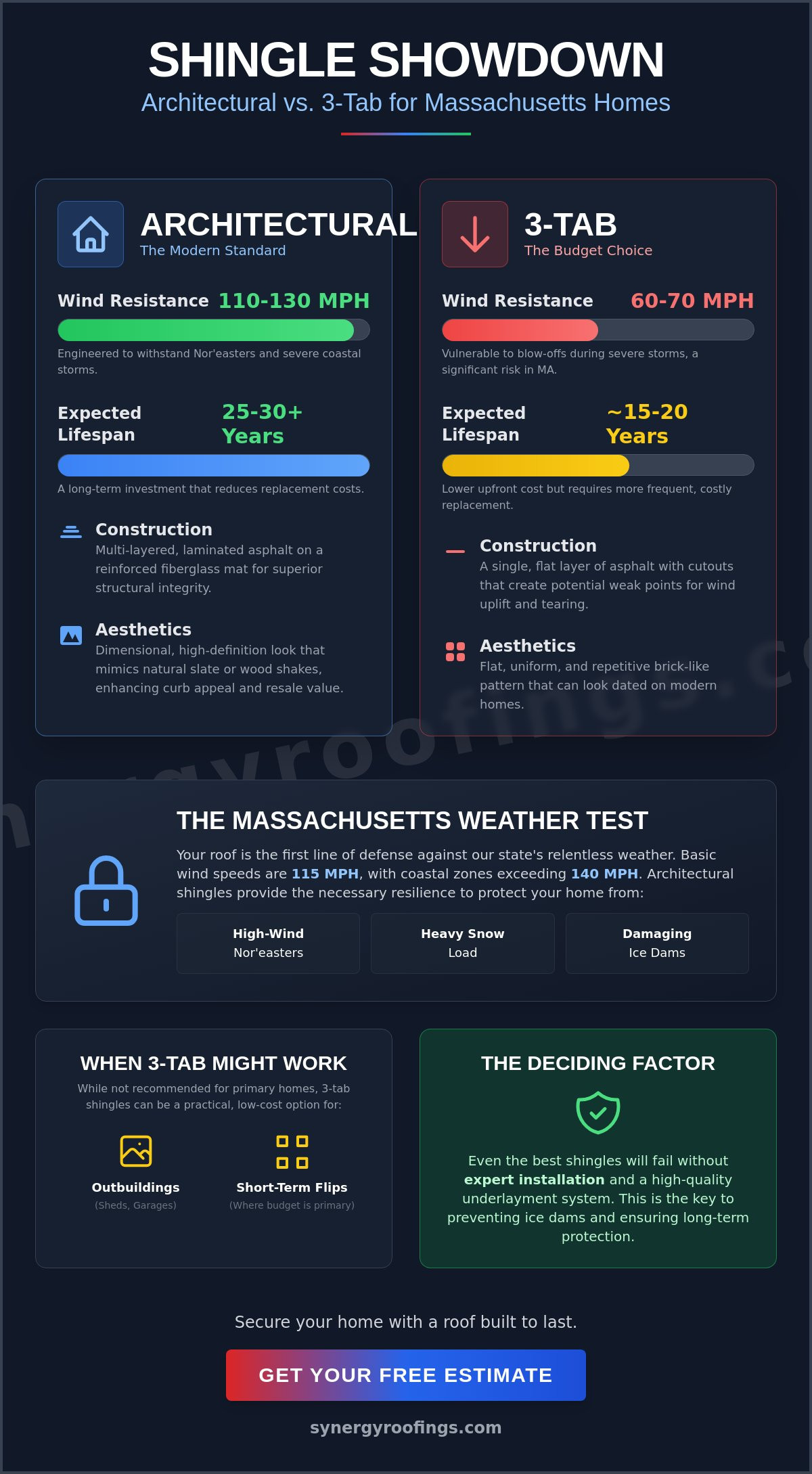
Massachusetts weather is a relentless test of structural integrity. Between the salt-heavy winds of a Nor’easter and the crushing weight of February snow, your roof faces a physical exam every single season. When evaluating architectural shingles vs 3-tab for ma homes, the most striking difference is how they handle high-velocity air. Traditional 3-tab shingles are typically rated for 60-70 mph winds. In a state where basic wind speeds are 115 mph and can exceed 140 mph in coastal zones, that rating simply isn’t enough to guarantee long-term safety.
Surviving the New England Nor’easter
Architectural shingles are engineered for resilience, carrying ratings of 110-130 mph. Their multi-layered, laminated design creates a much stronger seal against the roof deck. We’ve seen countless 3-tab roofs fail after major storms because the thin tabs catch the wind like a sail. This leads to widespread shingle blow-off that leaves the underlying wood vulnerable to water damage. At Synergy Roofing, we enhance this natural resistance by using high-wind starter shingles. This ensures the most vulnerable part of your roof, the edge, is locked down before the storm even arrives. This proactive approach turns your roof into a protective partner for your home rather than a potential liability.
Ice Dam Resistance and Thermal Cycling
Ice dams are a uniquely local headache that requires more than just a surface-level solution. The thickness of architectural shingles provides a more stable base for the critical ice and water shield underlayment required by the Massachusetts State Building Code. Because these shingles are denser, they handle the brutal thermal cycling of our region better than thin 3-tabs. Our temperatures can swing from -10°F in January to 95°F in July. This constant expansion and contraction cause thin shingles to crack or lose granules prematurely.
Heavier shingles also distribute snow loads more effectively. Ground snow loads in Massachusetts range from 25 psf in southeastern coastal areas to 55 psf or higher in the Berkshires. Architectural shingles provide the rigidity needed to support this weight without causing structural stress on the roof deck. This reduces the risk of leaks in valleys and eaves when the spring thaw begins. Beyond the winter risks, humid Massachusetts summers bring their own set of problems. The black streaks you see on older roofs are actually algae growth. Most modern architectural shingles manufactured in 2026 include specialized granules designed to resist this growth. This keeps your home looking safe and renewed, even after a humid New England August. Choosing a material that resists both the wind and the humidity is the best way to ensure your investment remains protected for decades.
Calculating the Real Value: Cost vs. Longevity in 2026
When you look at a roofing estimate, the bottom line is often the first thing that grabs your attention. It’s natural to feel a bit of sticker shock when comparing architectural shingles vs 3-tab for ma homes. However, the initial price tag is only one part of the story. In the 2026 market, the real value of a roof is measured by its cost per year of service. While architectural shingles have a higher initial cost, their per-year cost is significantly lower than 3-tab. Choosing the cheaper option today often leads to a much more expensive replacement project just 15 years down the road.
The lifespan reality in Massachusetts is particularly harsh on entry-level materials. While a 3-tab shingle might be rated for 20 years in a milder climate, our local cycle of ice dams and high winds usually limits their functional life to 15 or 18 years. Architectural shingles are built with multi-layered laminated construction that allows them to last 25 to 30 years or even longer. This durability is backed by superior warranties. Most manufacturers now offer “Lifetime” limited warranties on architectural products, whereas 3-tab shingles typically carry much shorter, limited coverage that depreciates quickly.
Your choice of material also has immediate implications for your monthly expenses. Many insurance providers in Massachusetts recognize the superior wind and impact resistance of architectural materials. Depending on your carrier, installing these high-performance shingles can lead to insurance premium discounts of up to 20%. This monthly saving helps offset the higher upfront investment while giving you the peace of mind that your home is a safer, more secure environment for your family.
ROI and Resale Value for Medway Homeowners
In the current Medway real estate market, savvy buyers are looking for homes that won’t require immediate capital improvements. A 3-tab roof is often viewed as a “deferred maintenance” red flag during a home inspection. It suggests that the next owner will be responsible for a full replacement in the near future. Conversely, architectural shingles can add around 6% to a home’s value. The dimensional, “shake-like” look creates an immediate boost in curb appeal that can lead to a faster sale and a higher appraisal value.
Maintenance and Repair Frequency
Choosing a thinner shingle often means committing to a more frequent schedule of minor fixes. 3-tab shingles are more prone to cracking and losing their adhesive seal, which leads to tabs lifting or blowing off entirely. This results in more frequent calls for roof leak repair to address small vulnerabilities before they turn into major attic damage. By investing in a heavier, more stable architectural shingle, you significantly reduce the likelihood of these annoying and costly maintenance interruptions over the next two decades.
Selection Guide: When Does 3-Tab Actually Make Sense?
While we consistently advocate for the superior security of multi-layered materials, we understand that every project has a specific set of constraints. There are rare instances where the lower upfront cost of 3-tab shingles aligns with a property owner’s immediate goals. For example, if you’re preparing a rental property for a short-term exit or finishing a quick “flip” in a neighborhood where 3-tab is the standard, the initial savings might seem practical. However, even in these cases, you must weigh the budget against the reality that Massachusetts wind speeds frequently exceed the 60-70 mph rating of these thinner shingles.
Outbuildings represent the most logical use for 3-tab materials. Sheds, detached garages, and small workshops often don’t require the 30-year lifespan or the heavy weight of an architectural system. If the structure is shielded from the wind by your primary residence or dense treelines, 3-tab shingles can provide a clean, uniform look at a lower price point. Additionally, if you’re performing a partial repair on an existing 3-tab roof in Norfolk County, matching the current material is often necessary to maintain a cohesive aesthetic, especially if local HOA requirements mandate a specific flat profile.
Matching the Architecture of Your Home
The classic Colonial and Cape Cod styles found throughout Medway generally benefit from the dimensional, “shake-like” texture of architectural shingles. This added depth complements the traditional lines of these homes. On the other hand, some mid-century modern designs with very low-pitched roofs look better with the clean, minimalist lines of a flat 3-tab shingle. When you consult with the best roofing companies in MA, we’ll help you evaluate which style enhances your specific home’s architecture while meeting modern safety standards.
Structural Considerations for Older Homes
Before you commit to a specific material, we must consider the structural health of your property. Architectural shingles are significantly heavier than 3-tab options, sometimes by as much as 50%. Many older homes in Massachusetts, particularly those built before 1900, have rafters that may require reinforcement before upgrading to a heavier system. A professional roof deck inspection is vital to ensure your home can support the weight of a multi-layered roof alongside the 55 psf snow loads common in our region. Proper ventilation is also a non-negotiable requirement for thicker shingles to prevent heat buildup that can shorten their lifespan.
If you aren’t sure which material is right for your specific structure, we can provide a detailed assessment of your roof’s current condition. Schedule your professional roof inspection today to ensure your property is ready for the seasons ahead.
The Synergy Approach: Expert Installation for Long-Term Protection
Choosing the right material is a critical first step, but even the most durable shingles are only as effective as the hands that install them. When you compare architectural shingles vs 3-tab for ma homes, you’re looking at products with vastly different engineering needs. A multi-layered architectural system requires specific nailing patterns and high-performance underlayment to meet its 130 mph wind rating. Without expert execution, you risk voiding manufacturer warranties and leaving your property vulnerable to the very Nor’easters you’re trying to avoid.
We treat every roof as a complete protective ecosystem. This means we don’t just “shingle” a house; we build a defense system. Our team focuses on the critical transition points where most leaks occur. We ensure that high-quality flashing is installed around chimneys and that your gutter system is optimized to handle the heavy runoff from spring thaws. If you’re looking to enhance your home’s interior while upgrading your exterior, we also specialize in Velux skylight integration. We make sure these features are seamlessly blended into your new architectural shingle system to prevent any moisture intrusion.
The Synergy Installation Difference
Our approach to asphalt shingle roofing begins with a comprehensive multi-point inspection. We examine the roof deck, rafters, and current ventilation to ensure your home can support the weight of modern architectural materials. Because we live and work in Medway, we understand the specific challenges of Norfolk County architecture. We prioritize the health of your chimney flashing and gutters because we know that a roof replacement is the best time to address these often-overlooked components. This attention to detail ensures your home remains safe and renewed for decades.
Next Steps for Your MA Roof Replacement
Starting a roofing project in 2026 doesn’t have to be a source of anxiety. We provide a straightforward process that begins with a transparent estimate comparing both 3-tab and architectural options. You’ll receive a clear explanation of the rationale behind our material suggestions based on your home’s specific structural needs and your long-term goals. During the project, you can expect a clean workspace, constant communication, and a final result that boosts your home’s curb appeal and resale value. We’re here to act as your guide through every technical choice and administrative step.
Don’t leave your home’s safety to chance. Schedule your free professional roof inspection with Synergy Roofing today! We’ll help you find the high-quality solution that fits your budget and protects your most valuable priority.
Secure Your Home’s Future with the Right Roofing Choice
Your roof is your home’s first line of defense against the unpredictable New England elements. We’ve looked at how structural differences impact everything from wind resistance during a Nor’easter to your home’s resale value in Medway. Ultimately, the choice between architectural shingles vs 3-tab for ma homes is about more than just aesthetics; it’s about investing in a solution that eliminates the stress of ice dams and storm damage for decades. You need a roof that works as hard as you do to protect what matters most.
With over 25 years of local Massachusetts roofing experience, our team knows exactly what it takes to safeguard your property. As Certified Velux Skylight Specialists who focus on leak prevention and storm damage, we ensure every detail of your installation meets the highest standards of reliability. You deserve a roof that offers quiet confidence and lasting protection. We take pride in being a protective partner for your most valuable asset, providing straightforward solutions that stand up to the harshest winters.
Ready to see which option best fits your home and budget? Get Your Free Medway Roofing Estimate today and partner with experts who prioritize your home’s safety. We look forward to helping you build a roof that stands the test of time.
Frequently Asked Questions
Are architectural shingles worth the extra cost in Massachusetts?
Yes, architectural shingles provide a much better return on investment because they typically last twice as long as 3-tab options. In our local climate, the cost per year of a multi-layered roof is significantly lower. You’ll avoid the high cost of a second replacement project just 15 years down the road. They also add immediate value to your property, making them the clear choice for homeowners planning to stay in their homes for the long haul.
Do architectural shingles last longer than 3-tab shingles in cold climates?
Architectural shingles are specifically designed to handle the brutal thermal cycling we experience in New England. Their laminated, multi-layered construction allows them to expand and contract without cracking or losing granules as easily as thinner materials. While a standard 3-tab shingle often becomes brittle after a few harsh winters, architectural shingles maintain their flexibility and structural integrity for 25 to 30 years or more in cold climates.
Can I install architectural shingles over my existing 3-tab roof?
While the Massachusetts State Building Code allows for up to two layers of asphalt shingles, we generally recommend a full tear-off. Installing new shingles over an old roof prevents us from inspecting the roof deck for rot or structural damage. It also adds significant weight to your rafters. For a truly reliable result, stripping the old layer ensures your new investment is bonded directly to a healthy, secure surface.
How much wind can architectural shingles withstand compared to 3-tab?
The difference in wind resistance is substantial. Architectural shingles are typically rated to withstand winds between 110 and 130 mph, while most 3-tab shingles are only rated for 60 to 70 mph. This is a vital distinction when comparing architectural shingles vs 3-tab for ma homes. Given that coastal Massachusetts can experience wind gusts exceeding 100 mph during a severe Nor’easter, the extra protection is a necessary safeguard for your property.
Will architectural shingles help prevent ice dams better than 3-tab?
Architectural shingles don’t stop ice dams on their own, but their thickness and weight provide a superior foundation for ice and water shield underlayment. They handle the pressure of heavy snow loads better than thin shingles, which reduces the chance of structural stress. When paired with proper attic ventilation and professional installation, these shingles are a critical component in preventing the leaks that typically follow a heavy spring thaw.
Is there a weight difference between architectural and 3-tab shingles?
Yes, there is a major weight difference. Architectural shingles are often 50% heavier than 3-tab shingles because of their multiple layers of asphalt and fiberglass. This extra mass is what helps them stay put during high winds. Before upgrading, it’s important to have a professional verify that your home’s rafters and roof deck can support this additional weight, especially when combined with the heavy snow loads common in Norfolk County.
Does my choice of shingle affect my home insurance in Norfolk County?
Your choice can absolutely impact your premiums. Many insurance carriers in Norfolk County offer discounts of up to 20% for homes with certified impact-resistant or high-wind rated roofing materials. Because architectural shingles are less likely to blow off or leak during a storm, they represent a lower risk to the insurer. We recommend checking with your specific provider to see how a higher-quality roof can lower your annual property insurance costs.
What is the most popular shingle color for Massachusetts homes in 2026?
In 2026, Massachusetts homeowners are leaning toward sophisticated, natural tones that mimic organic materials. Charcoal grey, slate, and weathered wood remain the most popular choices because they complement classic Colonial and Cape Cod architecture. These neutral colors provide excellent curb appeal and help maintain a high resale value. They also hide minor debris and algae streaks better than lighter colors, keeping your home looking safe and renewed year-round.