

Choosing the lowest quote for a pressure-treated wood deck in 2026 might actually cost you more in maintenance and repairs over a 10-year period than a premium composite alternative. While the initial investment feels heavy, the relentless Massachusetts humidity and heavy snowfall turn traditional wood into a liability that requires staining every 2 years. We understand that researching composite decking prices massachusetts can feel overwhelming, especially when you’re trying to decode the difference between entry-level boards and high-performance capped polymers.
You want an outdoor space that lasts, but you don’t want to get lost in permit paperwork or overlook the 48-inch frost-line requirements mandated by local building codes. At Synergy Roofing, we believe in protecting what matters most by providing total transparency before the first board is laid. This guide gives you a clear framework for your 2026 project budget. We’ll break down material tiers, labor expectations, and the specific permit costs you’ll face in the Bay State to ensure your new deck provides ultimate peace of mind.
Key Takeaways
- Master your budget with a transparent breakdown of how materials, professional labor, and local permits shape your total investment.
- Compare leading brands like Trex and TimberTech to understand how specific material tiers and railing choices influence your project’s durability.
- Gain clarity on composite decking prices massachusetts for 2026, including a look at how Norfolk County regulations and permit fees affect your final quote.
- Discover the Synergy approach to home health, ensuring your new deck installation protects your siding and roofline from long-term damage.
- Navigate the Massachusetts State Building Code with confidence to guarantee your outdoor space is both beautiful and structurally sound.
Estimating the Investment: Average Composite Decking Prices in Massachusetts for 2026
Choosing the right materials for your home is about more than just aesthetics; it is about long-term protection and reliability. Composite decking is a blend of wood fibers and recycled plastic designed for extreme weather resistance. As we look at the market for 2026, these Wood-plastic composites (WPCs) have become the standard for homeowners who want to avoid the constant cycle of sanding and staining. In Massachusetts, our weather moves from freezing winters to humid, salty air along the coast, making durable materials a necessity rather than a luxury.
To better understand how these materials perform and what to look for before starting your project, watch this helpful video:
The 2026 Price Range Per Square Foot
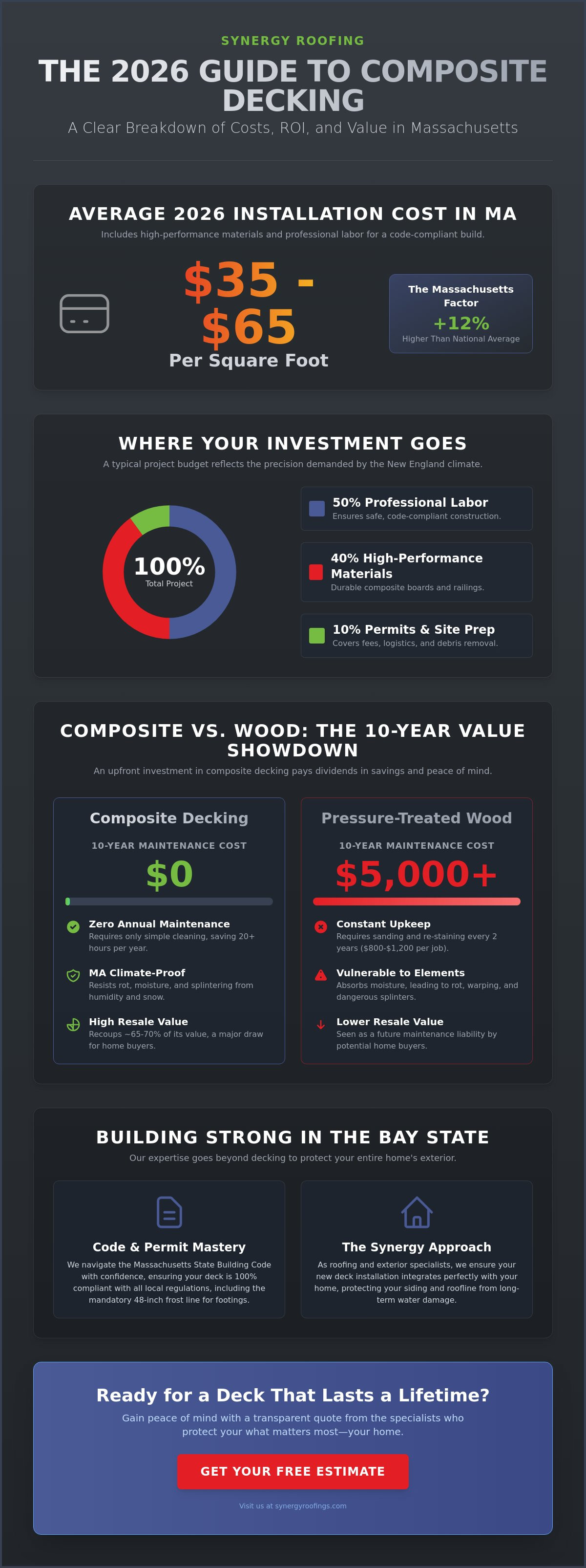
For a professional installation in 2026, composite decking prices massachusetts average between $35 and $65 per square foot. This range includes both the high-performance boards and the professional labor required for a seamless finish. You will find that local prices often trend 12% higher than the national average. This is largely due to the specialized labor rates in New England and the logistical costs of transporting heavy materials into our historic neighborhoods.
Supply chain stability has improved significantly compared to the volatility seen in 2022. By 2026, manufacturers have streamlined production, which leads to more predictable pricing for your project. When you work with a dedicated partner like Synergy Roofing, you get the benefit of this stability combined with local expertise. We focus on ensuring your investment is protected from the first day of construction.
Composite vs. Wood: The Long-Term ROI
While a pressure-treated wood deck might cost less upfront, the 25-year lifecycle savings of composite are undeniable. In Norfolk County, real estate data shows that high-quality composite decks retain approximately 65% to 70% of their value during a home sale. This is a significant advantage in a competitive market where buyers prioritize low-maintenance features.
Consider the financial burden of traditional wood over a decade. A standard wood deck requires professional sealing every two years, costing roughly $800 to $1,200 per treatment. Over 10 years, you spend $5,000 just on maintenance. Composite decking brings that annual cost down to $0. It provides a “peace of mind” factor that wood cannot match. You won’t have to worry about rot during our humid July weeks or splintering after a heavy February freeze. It is an investment in your time and your home’s structural integrity.
- Zero Annual Sanding: Save 20+ hours of labor every spring.
- Rot Resistance: Composite boards do not absorb moisture, preventing structural decay.
- Fade Protection: Modern UV-inhibitors ensure your deck looks the same in year 10 as it did on day one.
Breaking Down the Costs: Materials, Labor, and the Massachusetts Factor
Understanding where your investment goes helps ensure long-term durability and peace of mind. In 2026, composite decking prices massachusetts projects typically follow a specific financial blueprint. You can expect 40% of your budget to cover high-quality materials, while 50% pays for the specialized labor required for a safe, code-compliant build. The remaining 10% covers essential permits, site preparation, and debris removal. This breakdown reflects the reality of the New England construction market, where craftsmanship and regulatory compliance are paramount.
Massachusetts weather demands this precision. Our local climate features high humidity and rapid temperature swings that can warp inferior products. We focus on a “synergy” between premium components and expert installation to protect your home from these elements. When you invest in a deck, you aren’t just buying boards; you’re securing a structure that must withstand heavy snow loads and coastal winds.
Material Costs: Tiers of Composite Quality
Materials fall into three distinct categories based on their protection levels and aesthetic finishes. Choosing the right tier depends on your long-term goals for the property.
- Entry-level “Good” composites: These boards often feature scalloped bottoms to reduce weight and cost. They offer basic durability but come with limited color palettes and thinner capping.
- Mid-range “Better” composites: These options include 3-sided capping and enhanced wood grain patterns. They provide a more realistic look and better resistance to mold and mildew in damp Massachusetts springs.
- Premium “Best” composites: These top-tier products utilize 4-sided polymer capping and advanced heat-reduction technology. These boards stay significantly cooler under the July sun and offer the highest stain resistance available in 2026.
Labor Costs: Why Local Expertise Matters
Labor is the largest variable in your project budget. Licensed MA contractors base their rates on the complexity of your design, such as multi-level platforms, wrap-around stairs, or integrated LED lighting systems. A critical factor for any local build is the 4-foot frost line depth required by state building codes. If your contractor doesn’t secure footings at this depth, New England’s winter freeze-thaw cycles will heave your deck and compromise its structural integrity within just a few seasons.
Before signing any agreement, verify your builder follows the Massachusetts Home Improvement Contractor Law to protect your rights as a homeowner. Seasonal demand also shifts composite decking prices massachusetts. Booking during the peak spring rush can increase labor costs by 12% to 15% compared to late autumn scheduling. Just as you would look for expert craftsmanship when choosing the Best Roofers in Massachusetts, your deck builder must prioritize structural safety over speed.
We believe in total transparency and helping you make informed decisions for your most valuable asset. Our goal is to provide a seamless experience that results in a beautiful, lasting restoration of your outdoor space. If you’re ready to explore your options, we can help you find a high-quality solution tailored to your specific needs.
Choosing Your Tier: Brand Comparisons and Feature Impact
Selecting the right material for your home involves more than just picking a color. Your choice of brand directly dictates the composite decking prices massachusetts homeowners pay, often shifting the total project cost by $3,500 to $12,000 depending on the specific product tier you select. We see Trex as a frequent choice for its accessibility and broad color palette. Azek and TimberTech offer premium PVC and capped composite options that resist the harsh coastal salt and high humidity found in our region. Research from the USDA Forest Service highlights the long-term durability of composite materials, confirming they withstand environmental stressors far better than traditional pressure-treated lumber.
Your railing system is another major variable that impacts your overall budget. Upgrading from standard composite balusters to modern cable or glass systems can swing your final price by 20% or more. While these high-end options offer unobstructed views of your landscape, they require specialized hardware and more intensive labor during the installation process. You should also consider the fastener system. Hidden fasteners provide a seamless look while protecting the board integrity from moisture. They eliminate the surface holes where water often collects, which is a critical consideration for our wet New England springs.
Brand Performance in New England
Massachusetts winters test every material. Brands like Azek excel here because their cellular PVC composition doesn’t absorb water, making them immune to the freeze-thaw cycles that crack cheaper boards. You’ll find that 50-year fade and stain warranties are now the standard for top-tier lines, compared to the 25-year coverage on entry-level products. At Synergy Roofing, we ensure local availability of popular earth tones and greys in the Medway area, so your project stays on schedule despite regional supply shifts.
Hidden Costs: Substructure and Framing
Your new deck is only as reliable as the pressure-treated frame beneath it. We always recommend applying joist flashing tape during construction. It’s a small investment, typically adding only a few hundred dollars, that prevents frame rot in the high humidity of a Massachusetts summer. If you want a deck that lasts 40 years or more, you might consider light-gauge steel framing. It won’t warp or sag like wood, ensuring your investment remains level and secure for decades without the risk of structural decay.
Local Variables: How Permits and Norfolk County Regulations Impact Your Quote
Building a high-quality deck involves more than just selecting the right boards. It requires strict adherence to the Massachusetts State Building Code, specifically 780 CMR. These regulations ensure that every structure can withstand our heavy snow loads and high winds. When calculating composite decking prices massachusetts, homeowners often overlook the administrative costs that guarantee safety and legal compliance. In towns like Medway or Littleton, permit fees are typically calculated based on the project’s value. In 2026, many municipalities charge roughly $15 per $1,000 of estimated construction costs. This means a $30,000 deck project will include a $450 permit fee right at the start.
Local building departments require professional site plans and structural drawings before they issue a permit. These documents must detail your footing depths, joist spacing, and railing attachments. Skipping this step isn’t an option for a reputable contractor. If you are also planning a roof replacement to match your new outdoor space, it helps to work with the top roofing companies in MA who already understand these strict local filing processes. We believe that doing things right the first time provides the ultimate peace of mind.
The Permitting Process in Norfolk County
Expect a standard review timeline of 14 to 21 business days for most Norfolk County building departments in 2026. While it’s tempting to start digging immediately, skipping the permit is a high-risk move. Unpermitted work can lead to denied insurance claims after storm damage and will certainly complicate your home resale process. Your project will require three specific check-ins: an inspection of the footings before concrete is poured, a framing inspection to verify structural integrity, and a final safety check once the stairs and railings are secure.
Site Preparation and Environmental Factors
Your backyard’s current condition plays a major role in your final quote. Removing an existing pressure-treated wood deck usually costs between $800 and $2,200, depending on the size and the complexity of the demolition. Disposal fees at Massachusetts transfer stations have seen a 15% increase since 2024, which adds to the bottom line. Beyond demolition, our local geography presents unique challenges. Massachusetts soil is often filled with “glacial till,” which is a polite way of saying large, stubborn rocks. If our team hits a boulder while digging footings, it requires specialized equipment and more labor hours. We also prioritize proper drainage. Ensuring the ground slopes away from your foundation is essential for protecting what matters most: the structural health of your entire home.
Ready to build a deck that stands the test of time? Contact Synergy Roofing today for a professional consultation on your next exterior project.
Beyond the Price Tag: Why the Synergy of Roofing and Decking Matters
Your home’s exterior functions as a single, integrated system designed to shed water and resist the elements. When researching composite decking prices massachusetts homeowners often focus exclusively on the square footage and material costs. However, the most critical part of any deck is the connection point to your house. At Synergy Roofing, we view your deck as an extension of your home’s protective shell. We apply the same rigorous waterproofing standards to a deck ledger board that we apply to a complex roof valley or chimney flashing.
A deck that’s installed without considering the “synergy” of the entire exterior can lead to catastrophic failures. If the flashing where the deck meets the house isn’t executed with roofing-grade precision, water will eventually find its way behind your siding. This leads to rim joist rot, mold growth, and structural instability that can cost thousands to repair. By choosing a specialist who understands the relationship between your roof, gutters, and deck, you ensure that one project doesn’t create a hidden problem for another.
Coordinated Exterior Maintenance
We don’t just look at your backyard; we look at your entire property. Our team evaluates your roof-line and gutter system during every deck planning phase. If your gutters are undersized or clogged, heavy rainfall can overflow directly onto your deck, causing premature wear and splashing water against vulnerable siding joints. We ensure your ledger board is flashed with high-quality materials that meet 2026 building standards, preventing moisture from ever touching your home’s framing. This “one point of contact” approach simplifies your restoration and provides a level of craftsmanship that general “deck-only” contractors often overlook.
Next Steps for Your Medway Home
Preparing for a 2026 project requires a clear understanding of your home’s current health. When you schedule a consultation, we’ll perform a comprehensive check of your exterior to identify any underlying issues that could impact your new installation. A professional estimate should be transparent, detailing everything from joist spacing to the specific fasteners used to combat the Massachusetts climate. You deserve the peace of mind that comes from a project built to last. Request a Free Exterior Assessment and Decking Quote Today to start your journey toward a more beautiful, protected home.
Secure Your Home’s Value for 2026
Navigating composite decking prices massachusetts requires a clear look at how material tiers and regional labor rates intersect. Since the 2024 update to the Massachusetts State Building Code, requirements for structural resilience have become more stringent, making professional installation a necessity for long-term safety. You’ve seen how Norfolk County permitting fees and local zoning laws shift your total investment, but the true value lies in the longevity of the materials you choose. It’s about more than just a surface; it’s about the foundation of your outdoor living space.
We bring over 20 years of Massachusetts craftsmanship to every project, ensuring your deck works in harmony with your roof to protect your most valuable asset. As Velux Skylight Specialists, we understand the technical details that prevent water intrusion and maintain your home’s integrity. Choosing a partner who prioritizes A+ rated protection gives you the peace of mind you deserve. We’re ready to help you achieve the perfect synergy of style and durability for your property.
Get Your Free 2026 Composite Decking Quote
We look forward to helping you build a beautiful, lasting space for your family to enjoy.
Frequently Asked Questions
Is composite decking more expensive than wood in Massachusetts?
Composite decking typically costs more upfront than pressure-treated lumber. While the initial investment is higher, you save money over time because you don’t have to pay for annual staining or sealing. In the 2023 Cost vs. Value report, composite decks regained 39.8 percent of their cost in home resale value. We focus on durability to ensure your composite decking prices massachusetts investment provides peace of mind for decades.
Do I need a building permit for a deck in Medway, MA?
You definitely need a building permit for any deck construction in Medway. The Massachusetts State Building Code, specifically 780 CMR, mandates permits for all structural additions to ensure safety and integrity. Our team handles the application process with the Medway Building Department to keep your project on schedule. This collaborative approach ensures your new deck meets 100 percent of local safety standards while protecting what matters most.
How long does a composite deck last in the New England climate?
A high-quality composite deck typically lasts 25 to 30 years in our harsh New England weather. Unlike wood, these boards won’t rot or warp during a 12 inch snowstorm or a humid July heatwave. Most manufacturers provide a 25 year fade and stain warranty to guarantee lasting beauty. We select materials with a proven track record of durability to provide a seamless transition from your home to your outdoor space.
Will composite decking get too hot for bare feet in the summer?
Older composite materials absorbed heat, but modern boards feature advanced heat-mitigation technology. Some premium collections are engineered to stay 30 percent cooler than traditional composite products. If your deck faces direct southern sun, we recommend choosing lighter colors to improve comfort. This choice ensures your family can enjoy the deck safely even during a 90 degree August afternoon. It’s about creating a comfortable environment for your home.
Can I install composite decking over my old wood frame?
You can install new boards over an existing frame if the joists are structurally sound and meet current codes. We perform a 10 point inspection of your current substructure to check for rot or hardware failure. If the frame is over 15 years old, it usually makes sense to replace it for long-term security. Our goal is to create a synergy between the new surface and the underlying support for total peace of mind.
What is the best time of year to build a deck in Massachusetts?
Late fall and early winter are actually the best times to schedule your project. Building during the off-season avoids the 6 week backlog common during the spring rush. The frozen ground also prevents heavy equipment from damaging your lawn. By planning ahead, your deck will be ready for the first warm day in April. We pride ourselves on maintaining a steady rhythm to complete your restoration efficiently.
Does composite decking require any maintenance at all?
Composite decking is low-maintenance, but it isn’t no-maintenance. You should wash your deck twice a year with soap and water to remove pollen and debris. This simple routine prevents mold growth and keeps the surface looking like new. You’ll never need to sand, strip, or stain the boards again. This ease of care is a primary reason why composite decking prices massachusetts are seen as a smart long-term value for busy homeowners.
How does a new composite deck impact my property taxes in MA?
Adding a deck increases your home’s fair market value, which typically leads to a modest increase in property taxes. Local assessors in Massachusetts view a permanent deck as a property improvement. However, the 2023 Cost vs. Value report shows that the increase in home equity often outweighs the small bump in annual taxes. We provide the documentation you need for a transparent experience with your local municipality.